
LBMA Good Delivery Gold Bars — Refinery-Origin Supply

What Is the LBMA Good Delivery Framework?
Definition of the Framework
- The LBMA Good Delivery framework is a technical and conformity standard governing large-format gold bars used in international wholesale bullion markets.
- It defines the eligibility criteria required for a bar to be accepted within recognized trading environments.
- The framework applies to bar specifications and refinery approval status.
Scope of Regulation
- The standard establishes minimum fineness thresholds and defined weight ranges.
- It requires mandatory markings, including refinery hallmark and unique serial identification.
- Physical characteristics and dimensional tolerances are part of conformity evaluation.
- Only approved refiners may produce bars recognized under the framework.
Framework Boundaries
- The Good Delivery framework defines bar-level conformity, not pricing.
- It does not regulate vault storage operations or transport logistics.
- Market acceptance depends on compliance with specification and refinery approval status.
Market Recognition and Standardization

LBMA Certification, Refineries and Origin Control
Refinery Approval Framework
- Only refiners meeting defined technical, financial, and operational criteria may produce bars recognized under the Good Delivery framework.
- Refinery approval requires demonstration of production capability, quality control systems, and consistency in meeting specification parameters.
- Approved refiners are listed within the recognized Good Delivery refinery register.
Certification and Ongoing Monitoring
- Refinery status is subject to ongoing compliance monitoring and periodic review.
- Conformity testing procedures may include assay verification and sample analysis.
- Failure to maintain standards may affect refinery approval status.
Origin Control and Responsible Sourcing
- Approved refiners are expected to operate under responsible sourcing frameworks.
- Supply chain due diligence forms part of conformity expectations within the Good Delivery system.
- Origin transparency supports market integrity and cross-border acceptance.
Relationship to Recognized Gold Bar Formats

Refer to:
400 oz Gold Bars
Official Supplier of Heraeus Precious Metals
Golden Ark Reserve is an official supplier of Heraeus Precious Metals for refinery-origin precious metals products.
Heraeus Precious Metals is part of the Heraeus Group, whose industrial origins date to 1851. Today is a global leader in the precious metals industry, covering the full value chain from trading and refining to bullion products and recycling.
We supply gold bars bearing the stamps of Heraeus Ltd (Hong Kong) and Argor-Heraeus SA (Switzerland), which is part of the Heraeus Group and is internationally recognized for LBMA Good Delivery refinery standards.

Request 400 oz Gold Bar Proposal
Request a proposal covering pricing, allocation, vault placement, or physical delivery for the 1 kg gold bar format. Subject to onboarding, compliance review, product availability, and execution conditions.
Go to Request Form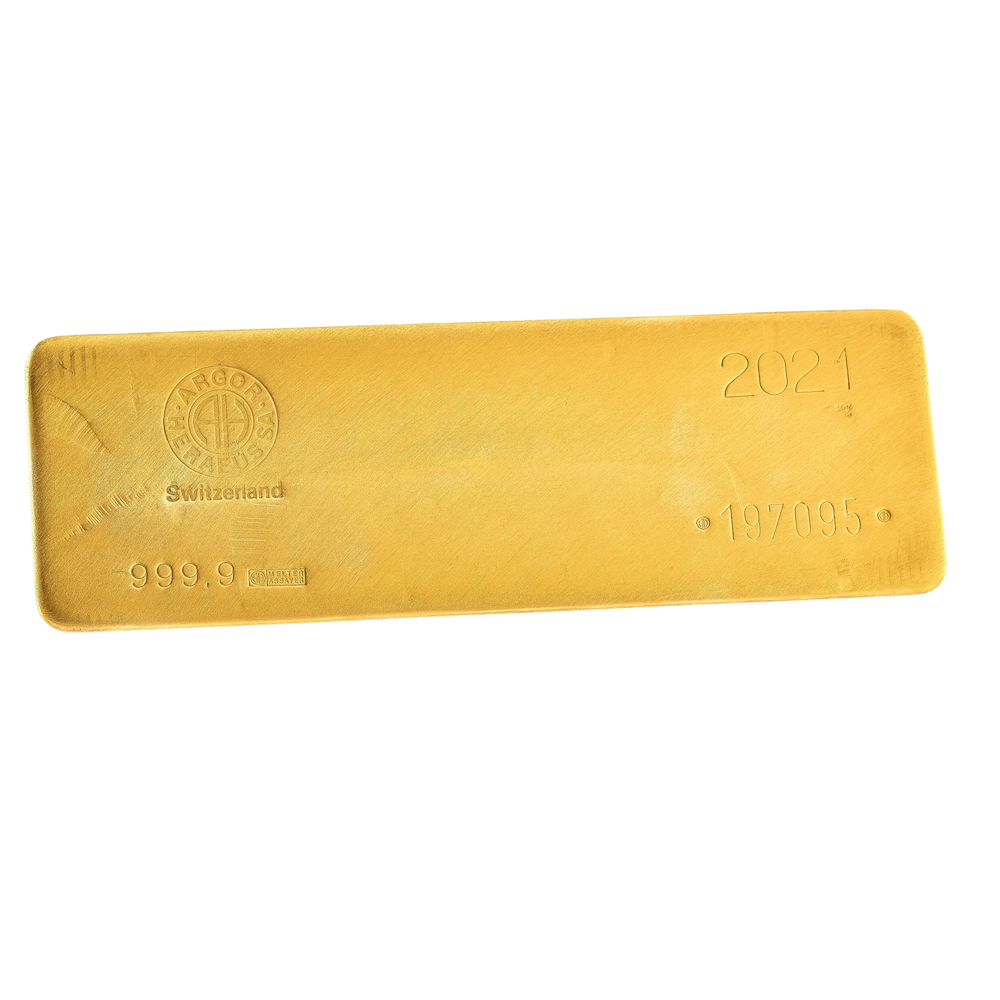
Provenance and the digital bar record
Confirming a specific bar’s purity means destroying part of it. The LBMA endorses no non-destructive testing method, and accurate fineness comes only from destructive assay of representative samples. Sampling a ≈400-ounce bar to prove its fineness falls outside wholesale settlement practice, so a buyer relies on the bar’s record rather than a test of the metal in hand.
In place of a test, the market trusts the credential and the record. A Good Delivery bar clears into approved custody at sight on two supports:
- the accreditation behind the refiner’s mark, held in place by the monitoring cycle
- an unbroken custody chain from the foundry forward
The chain removes re-assay at each handover; where a bar leaves it — private custody, an unaccredited carrier, a documentation gap — the metal is unchanged while at-sight acceptance is forfeited, and a re-assay step re-enters the transaction. The handover mechanics, and what a custody break costs at exit, run in the format comparison.
Two physical details reinforce the marks the chain depends on:
- marks are struck by pressure stamp or pneumatic punch and never laser-engraved, which keeps the serial and fineness tamper-evident at every inspection
- porosity has become a casting-quality concern vaults watch on acceptance
Title to a bought bar therefore rests on its documented identity. In a Golden Ark Reserve transaction every record carries the same serial:
- the purchase agreement naming refiner, serial, gross weight, and fineness
- the refiner’s assay certificate or the 400-ounce weight list
- the AML and KYC file
- the payment confirmation
- the allocation record posted to the buyer’s account
Golden Ark Reserve coordinates that set and does not hold the gold — the bar sits at the third-party vault under the buyer’s allocated account, with Brink’s executing storage and movement. Each document points at the same physical unit, so title attaches to a specific bar and reconciles on audit.
Verification and title
Confirming a specific bar’s purity means destroying part of it. The LBMA endorses no non-destructive testing method, and accurate fineness comes only from destructive assay of representative samples. Sampling a ≈400-ounce bar to prove its fineness falls outside wholesale settlement practice, so a buyer relies on the bar’s record rather than a test of the metal in hand.
In place of a test, the market trusts the credential and the record. A Good Delivery bar clears into approved custody at sight on two supports:
- the accreditation behind the refiner’s mark, held in place by the monitoring cycle
- an unbroken custody chain from the foundry forward
The chain removes re-assay at each handover; where a bar leaves it — private custody, an unaccredited carrier, a documentation gap — the metal is unchanged while at-sight acceptance is forfeited, and a re-assay step re-enters the transaction. The handover mechanics, and what a custody break costs at exit, run in the format comparison.
Two physical details reinforce the marks the chain depends on:
- marks are struck by pressure stamp or pneumatic punch and never laser-engraved, which keeps the serial and fineness tamper-evident at every inspection
- porosity has become a casting-quality concern vaults watch on acceptance
Title to a bought bar therefore rests on its documented identity. In a Golden Ark Reserve transaction every record carries the same serial:
- the purchase agreement naming refiner, serial, gross weight, and fineness
- the refiner’s assay certificate or the 400-ounce weight list
- the AML and KYC file
- the payment confirmation
- the allocation record posted to the buyer’s account
Golden Ark Reserve coordinates that set and does not hold the gold — the bar sits at the third-party vault under the buyer’s allocated account, with Brink’s executing storage and movement. Each document points at the same physical unit, so title attaches to a specific bar and reconciles on audit.
Onboarding, allocation, storage, and delivery
Before any metal is committed, the transaction clears a front gate. Counterparty eligibility is screened first:
- AML and KYC checks and source-of-funds review
- Sanctions screening against the OFAC, EU, UK, and UN regimes via Refinitiv World-Check
- Heraeus supplier terms and LBMA supply-chain standards applying in parallel
A proposal is priced against the LBMA reference and firmed only against a cleared counterparty; there is no executable price to act on before onboarding. Onboarding and the purchase pathway run through physical gold purchase.
Past the gate the sequence is fixed:
- The contract names refiner, weight, fineness, and the serials bought.
- The named bars are allocated to the counterparty’s allocated account.
- Custody passes to the operator, not to Golden Ark Reserve — the bars sit at a third-party vault under the buyer’s account, with Brink’s executing storage and movement against contract, while Golden Ark Reserve holds none of the metal.
Delivery is where the holding leaves the vault, and the unit size sets the terms. A ≈400-ounce bar is a single ≈12.4-kilogram block that ships whole; it cannot be split to satisfy a partial movement without re-barring at an accredited refiner, which resets the manufacture date and the chain of integrity the bar’s at-sight acceptance depends on. Brink’s carries allocated bars under accredited carriage for cross-border delivery, with documented release at one vault and acceptance at the other. The shipment’s Incoterms then fix the point at which risk passes from seller to buyer in transit.
Settlement execution is determined by commercial agreements between counterparties operating within recognized market practice. Conformity status supports standardized treatment of bars within wholesale settlement environments but does not substitute for contractual settlement arrangements.