

LBMA Good Delivery Gold Bars — Refinery-Origin Supply

Good Delivery bars supplied by Golden Ark Reserve
Under this standard, the format Golden Ark Reserve provides is the 400-ounce gold bar cast by Heraeus and Argor-Heraeus SA, both on the current LBMA Good Delivery List for gold. The mark struck at the foundry is the one a receiving vault reads against that List, so the bar clears into approved custody at sight as the production of a listed refiner — not as metal re-stamped or re-marketed by an unlisted intermediary. Golden Ark Reserve sources it through the Heraeus official-supplier framework, which fixes refinery origin at a single accountable point.
Two figures fix the metal a bar carries:
- gross weight inside the 350-to-430 fine-troy-ounce band — the ≈400-ounce, ≈12.4-kilogram block the wholesale market settles around
- a minimum acceptable fineness of 995.0 parts per thousand fine gold
Bars are routinely cast finer, at 999.9; that exceeds the 995.0 floor rather than redefining it. Value settles on the fine weight recorded against each bar’s serial number, and the invoice follows that figure, not the gross mass. The full dimensional and marking specification sits in the Good Delivery bar definition.
From the same refining lines, Golden Ark Reserve also supplies 1-kilogram bars, and the distinction binds at the contract stage. A kilobar carries the refiner’s accreditation but is not a London Good Delivery bar, so it clears outside loco-London at-sight settlement and trades through a different layer. Where a holding needs that smaller unit, format selection runs on the kilobar page.
Official Supplier of Heraeus Precious Metals
Golden Ark Reserve is an official supplier of Heraeus Precious Metals for refinery-origin precious metals products.
Heraeus Precious Metals is part of the Heraeus Group, whose industrial origins date to 1851. Today is a global leader in the precious metals industry, covering the full value chain from trading and refining to bullion products and recycling.
We supply gold bars bearing the stamps of Heraeus Ltd (Hong Kong) and Argor-Heraeus SA (Switzerland), which is part of the Heraeus Group and is internationally recognized for LBMA Good Delivery refinery standards.

Request 400 oz Gold Bar Proposal
Request a proposal covering pricing, allocation, vault placement, or physical delivery. Subject to onboarding, compliance review, product availability, and execution conditions.
Go to Request Form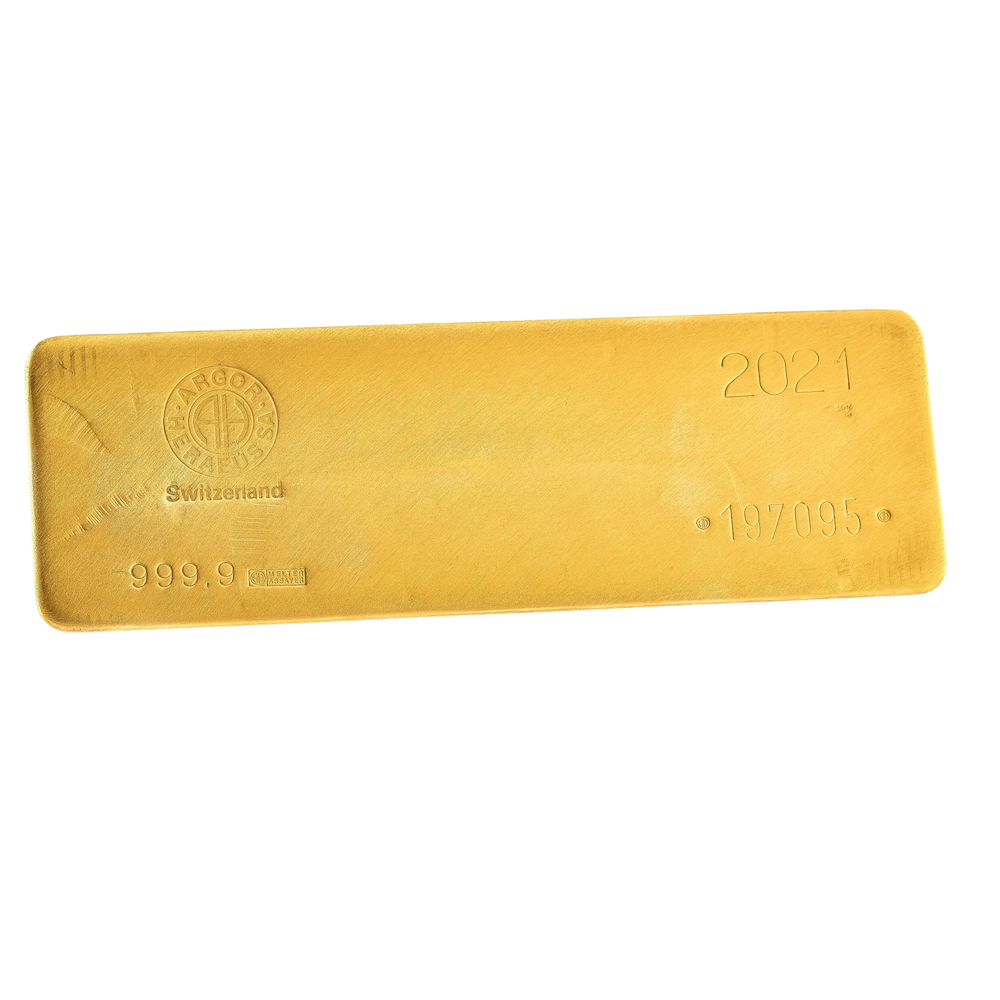
Provenance and the digital bar record
The record behind a Good Delivery bar’s origin no longer moves by email and PDF. The LBMA built a central governance database — the Gold Bar Integrity (GBI) system, built on distributed-ledger technology operated by aXedras — for the origin and responsible-sourcing data that listed refiners report. It went live in January 2025, and by the start of 2026 every Good Delivery refiner was using it to submit data and assurance deliverables. The data behind a listed refiner’s mark now posts into one validated record instead of scattering across correspondence.
The system runs on two layers:
- the database, which holds the governance and reporting data
- a physical security feature — a passport for the bar — that establishes and verifies a bar’s identity and links the metal to that record
The reporting is tightening on a schedule:
- country-of-origin reporting is moving to mandatory monthly submission
- periodic reporting goes live in the platform from April 2026
- the stated direction is bar-level reporting for custodians
Origin is shifting from a refiner-level attestation toward a record kept against the individual bar.
For a counterparty, this is the substance behind the mark a vault accepts at sight. The bars Golden Ark Reserve sources come from the Heraeus and Argor-Heraeus lines, both reporting into this system as listed refiners; Golden Ark Reserve coordinates supply against that record without operating the ledger itself. What the record cannot do is confirm the metal itself, and that sets the terms for how purity and title are established.
The 2026 Good Delivery Rules: what changed
Over time the LBMA revises the Good Delivery Rules that set the conditions a bar has to meet, and a new edition took effect on 1 January 2026. The marking and physical changes apply to new bars and to refiners applying for the List, not to bars already cast: the new rule applies to all new bar changes and List applicants from 1 January 2026 and does not apply to existing Good Delivery bars — so a holding bought earlier keeps its status and is not re-graded by the revision. The changes that bear on a counterparty evaluating supply:

| 2026 change | What it changes for a counterparty |
|---|---|
| New edition effective 1 Jan 2026, applied to new bars and new applicants | Bars already in approved custody keep their status; the revision does not strand or re-grade existing holdings. |
| Non-Roman, including Cyrillic, lettering no longer admitted in serial, date, and fineness marks | New Good Delivery bars carry Roman-script marks only, narrowing the marked production a counterparty screening origin has to account for. |
| Stamps and markings placed at least 10 mm from the edge of the bar | A placement standard for newly cast bars; it governs how new production is stamped and leaves existing bars and the metal untouched. |
| Proactive Monitoring timelines tightened, with periodic compliance and Responsible Sourcing reviews formalised | The accreditation behind a refiner’s mark is tested on a firmer cadence — the credential a counterparty relies on is maintained continuously, not granted once. |
| QR codes consulted and not introduced | Bar identity stays mark-and-record based; there is no scannable code on the bar, so provenance runs through the marks and the custody record. |
The Good Delivery Rules themselves are summarised in the Good Delivery standard. A machine-readable identity is the one element the rules deliberately kept off the bar, and it sits one layer back — in the digital record the market now maintains for every bar
Verification and title
Confirming a specific bar’s purity means destroying part of it. The LBMA endorses no non-destructive testing method, and accurate fineness comes only from destructive assay of representative samples. Sampling a ≈400-ounce bar to prove its fineness falls outside wholesale settlement practice, so a buyer relies on the bar’s record rather than a test of the metal in hand.
In place of a test, the market trusts the credential and the record. A Good Delivery bar clears into approved custody at sight on two supports:
- the accreditation behind the refiner’s mark, held in place by the monitoring cycle
- an unbroken custody chain from the foundry forward
The chain removes re-assay at each handover; where a bar leaves it — private custody, an unaccredited carrier, a documentation gap — the metal is unchanged while at-sight acceptance is forfeited, and a re-assay step re-enters the transaction. The handover mechanics, and what a custody break costs at exit, run in the format comparison.
Two physical details reinforce the marks the chain depends on:
- marks are struck by pressure stamp or pneumatic punch and never laser-engraved, which keeps the serial and fineness tamper-evident at every inspection
- porosity has become a casting-quality concern vaults watch on acceptance
Title to a bought bar therefore rests on its documented identity. In a Golden Ark Reserve transaction every record carries the same serial:
- the purchase agreement naming refiner, serial, gross weight, and fineness
- the refiner’s assay certificate or the 400-ounce weight list
- the AML and KYC file
- the payment confirmation
- the allocation record posted to the buyer’s account
Golden Ark Reserve coordinates that set and does not hold the gold — the bar sits at the third-party vault under the buyer’s allocated account, with Brink’s executing storage and movement. Each document points at the same physical unit, so title attaches to a specific bar and reconciles on audit.
Onboarding, allocation, storage, and delivery
Before any metal is committed, the transaction clears a front gate. Counterparty eligibility is screened first:
- AML and KYC checks and source-of-funds review
- Sanctions screening against the OFAC, EU, UK, and UN regimes via Refinitiv World-Check
- Heraeus supplier terms and LBMA supply-chain standards applying in parallel
A proposal is priced against the LBMA reference and firmed only against a cleared counterparty; there is no executable price to act on before onboarding. Onboarding and the purchase pathway run through physical gold purchase.
Past the gate the sequence is fixed:
- The contract names refiner, weight, fineness, and the serials bought.
- The named bars are allocated to the counterparty’s allocated account.
- Custody passes to the operator, not to Golden Ark Reserve — the bars sit at a third-party vault under the buyer’s account, with Brink’s executing storage and movement against contract, while Golden Ark Reserve holds none of the metal.
Delivery is where the holding leaves the vault, and the unit size sets the terms. A ≈400-ounce bar is a single ≈12.4-kilogram block that ships whole; it cannot be split to satisfy a partial movement without re-barring at an accredited refiner, which resets the manufacture date and the chain of integrity the bar’s at-sight acceptance depends on. Brink’s carries allocated bars under accredited carriage for cross-border delivery, with documented release at one vault and acceptance at the other. The shipment’s Incoterms then fix the point at which risk passes from seller to buyer in transit.