

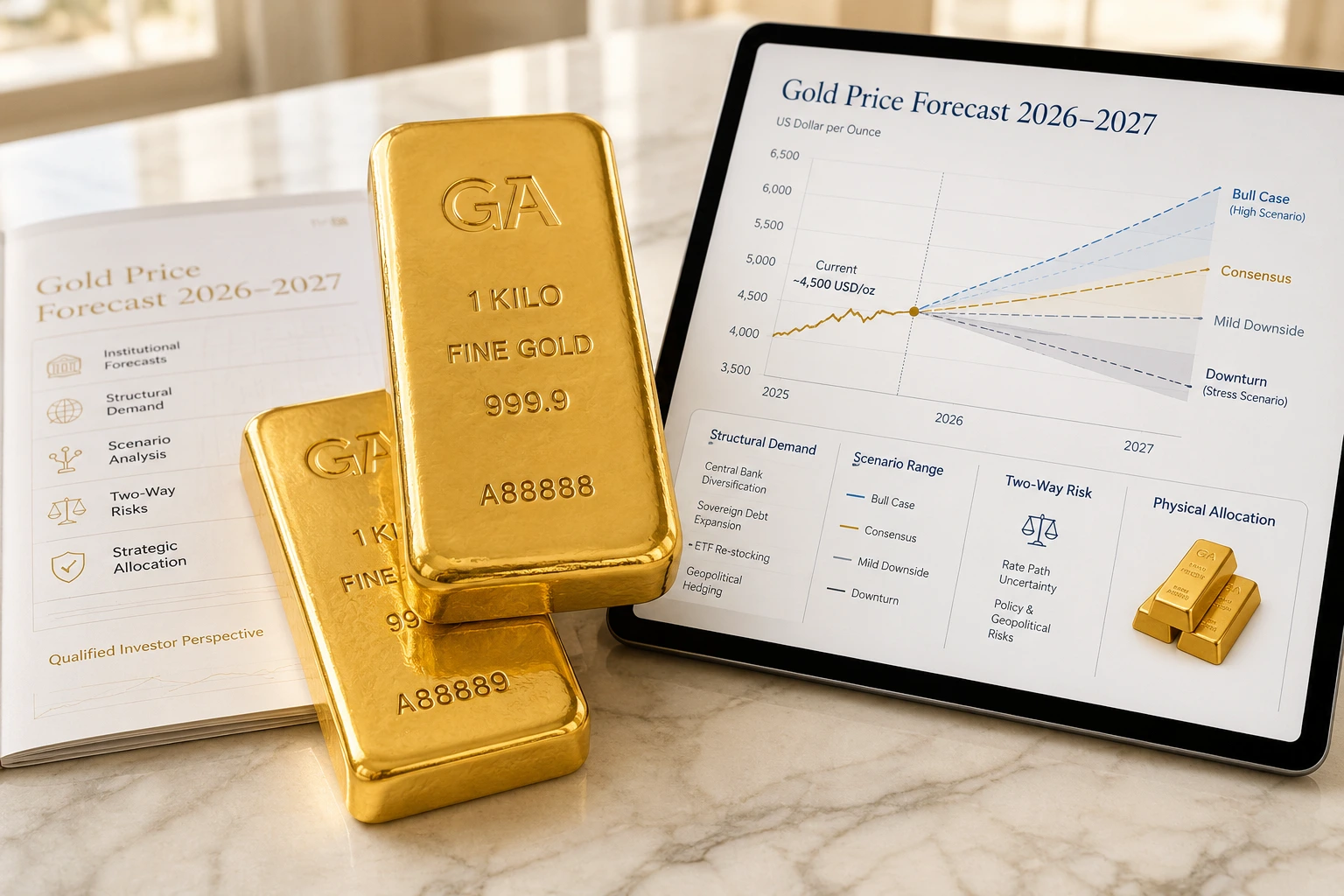
Gold is trading near $4,500 an ounce as of mid-2026, below the year-end targets most major banks set when the market still expected the US Federal Reserve to cut. The desks that move size — among them the investment banks JPMorgan, Goldman Sachs and UBS — still point higher, and so does the official-sector data of the World Gold Council, the gold-industry body. They ground that view in structural demand: central banks are rebalancing reserves into bullion, and sovereign-debt loads are climbing while mine supply expands slowly. Those same desks are explicit that the path runs both ways — a firmer dollar, or a Fed that holds or raises, would pressure the metal, as the March 2026 drop of more than 10% showed. What follows maps the 2026–2027 forecasts and the demand that underwrites them, then the conditions that would break the trend — the questions a treasury or family office weighs before sizing a physical position.
Where gold trades now
A record $5,595 on 29 January 2026 marked the peak; gold has since pulled back into a consolidation range and trades near $4,500, below both that high and the year-end targets most banks published earlier in the year. The level is the reference point against which every forecast that follows is read: a position opened today sits roughly 10–40% under the 2026 targets the major desks still hold, and only modestly above the floors their bearish cases imply.
That gap is the practical question for a buyer. Forecasters mostly expect the direction to be up; the distance from $4,500 to a year-end target is where the return — or the drawdown — actually lives, and which macro path runs decides it. How the quoted figure itself is assembled, across the London over-the-counter market, the COMEX futures exchange, and the daily benchmark of the London Bullion Market Association (LBMA), determines the spread and premium a counterparty pays on top of spot.
What forecasters expect for 2026–2027
Published forecasts lean higher, even as the targets disagree sharply on magnitude and several have moved in both directions since the January peak. Year-end 2026 calls from the major banks cluster between roughly $4,800 and $6,300. A poll of 31 analysts by the news agency Reuters returned a 2026 median near $4,916, below the loudest bank targets, which sit at the bullish edge of the field.
| Forecaster | 2026 target (USD/oz) | Note |
|---|---|---|
| JPMorgan (US) | 6,300 | Q4 2026; the top of the major-bank range |
| Wells Fargo Investment Institute (US) | 6,100–6,300 | Raised from 4,500–4,700 |
| BNP Paribas (France) | 6,250 | Cited as a peak, not year-end |
| ANZ (Australia) | 5,800 | Q2 2026; raised from 5,400 |
| UBS (Switzerland) | 5,500 | Lowered in May from 5,900 |
| Goldman Sachs (US) | 5,400 | Raised from 4,900 in January 2026; held through the March drop |
| Citi (US) | 5,000 | Short-term target |
| Commerzbank (Germany) | 5,000 | Raised from 4,400; about 5,200 into 2027 |
| Morgan Stanley (US) | ~4,800 | Q4 2026 base case; the most measured here |
Those revisions cut both ways, the part a momentum narrative omits. Wells Fargo lifted its year-end target to 6,100–6,300; UBS trimmed its late-2026 figure to 5,500 while keeping a constructive view; Commerzbank raised its number to 5,000 through the two-month decline. Goldman’s analysts moved their target to $5,400 in January and have held it since, calling the risk skewed to the upside; Morgan Stanley stays the most restrained, near $4,800 by the fourth quarter, with 2025’s momentum fading as the broader trend holds higher.
Beyond 2026 the projections widen. Commerzbank carries about $5,200 into 2027, and the upper end runs to extreme-demand scenarios: Bank of America analyst Michael Widmer has flagged $8,000 by 2027 in such a case, citing uncertainty over Federal Reserve leadership and large structural deficits, with investor allocations to gold still historically low. Across the field, 2027 targets span roughly $5,150 to $8,000. These long-dated figures carry the least conviction and the widest error, useful as a direction of travel and little more.
The dispersion is itself the signal. A $4,800-to-$6,300 band for a single year-end means the forecasters align on direction and divide on magnitude. The width of that band is the honest summary of where the field stands; any single point within it overstates the agreement behind it.
The structural demand underneath the calls
A demand structure that several independent buyers feed at once sits beneath the bull targets. Official-sector accumulation is the most cited leg. Central banks bought about 850 tonnes in 2025, down from the more than 1,000 tonnes purchased annually from 2022 through 2024 and still high by any earlier standard, and the buying concentrates in reserve managers diversifying away from dollar exposure. Since global tensions escalated in 2022, China has added more than 350 tonnes, Poland about 320 and ranked as the largest official buyer in 2025, Türkiye roughly 220 and India about 130. The European Central Bank (ECB) tied that demand to diversification and geopolitical risk, with its President, Christine Lagarde, attributing the sustained central-bank appetite to geopolitical tension. A treasury or family office applies the same logic when it treats gold as a strategic reserve asset, and forecasters read official buying as a standing bid largely independent of the investor cycle.
That reserve milestone, the one that drew headlines, needs reading with care. Gold reached 27% of official reserves at end-2025, ahead of US Treasuries at 22% — the first time bullion has outranked Treasuries by market value. Dollar-denominated assets together still hold the largest share at 42%. The new ranking is mostly a price effect: gold rose about 60% in 2025 after a 30% gain in 2024, and on the ECB’s own valuation-adjusted basis, holding the gold price at its end-2023 level, gold and the euro sit level near 16% while Treasuries remain ahead at 26%. The behavioural signal is that the largest and most price-insensitive owners of reserves kept buying as prices climbed.
Underneath official demand sits the fiscal backdrop the banks invoke directly. Goldman Sachs frames its target around a debasement thesis, with gold rebasing toward fair value near $4,000–$4,500 in a high-debt environment, and Bank of America’s Michael Widmer points to structural fiscal deficits and historically low investor allocations to gold as underappreciated supports. Those allocations are rebuilding from a low base: private investment demand nearly doubled from 2024 to almost 2,200 tonnes, and gold-backed ETFs drew a record $89 billion of inflows. A new buyer also appeared — stablecoin issuer Tether added more than 100 tonnes, more than any single central bank that year.
The supply side adds little slack. Mine output cannot expand quickly to meet a surge in demand, so that demand registers in price. Those supports hold only while the macro environment cooperates, and that is where the forecasts split.
The World Gold Council scenario frame
Where the bank targets give point forecasts, the World Gold Council’s outlook frames 2026 as a set of scenarios. Its Gold Outlook 2026 measures four of them against the average LBMA gold price for November 2025, and presents the ranges as illustrative outputs of its valuation framework — readings of how gold would behave under each macro regime, offered for scenario analysis.
| Scenario | Conditions | Implied move |
|---|---|---|
| Macro consensus | Current conditions persist; rangebound | −5% to +5% |
| Shallow slip | Mild slowdown, deeper Fed cuts, rotation into defensive assets | +5% to +15% |
| Doom loop | Deep downturn plus escalating geopolitical tension; flight to safety | +15% to +30% |
| Reflation return | Trump policy lifts growth, the Fed holds or hikes, dollar and real yields rise | −5% to −20% |
On the Council’s reading, the current price broadly reflects macro consensus — a rangebound year. Markets rarely track consensus for long. The Council leans toward the upside scenarios, given softer growth, accommodative policy and persistent geopolitical risk. In price terms, the base case maps to roughly $4,000–$4,500; a break above $4,550–$4,600 would open the path toward about $5,050, while a drop below $4,450 would risk a slide toward $4,000–$4,100.
Read this way, the framework turns a wide target range into conditional bets: the figure a position earns depends on which regime actually arrives. The single scenario that would pressure gold — reflation, with a firmer dollar and higher real yields — is the one whose early signs are visible now.
What could break the trend
Most of the higher targets share one premise: that the Federal Reserve would keep cutting. The Fed cut three times at the end of 2025, and its own projections still pencil in at least one more cut in 2026. That premise is weakening — firmer US inflation data has dimmed rate-cut hopes, and an analyst at the trading platform Capital.com notes the market beginning to price the next move as a possible hike by year-end. The Fed held its benchmark at 3.5–3.75% in March, a second hold after the end-2025 cuts, and a June cut is now a non-starter.
From here, four developments would put the price under pressure.
- If the Fed holds and the dollar stays firm, a non-yielding asset loses appeal — the CME FedWatch tool, which reads rate-move odds from futures pricing, already puts a quarter-point December hike near 40%, and a separate reading shows a 60% chance of no cuts in 2026.
- Inflation and oil reignite. Oil pushed above $100 a barrel after the war with Iran disrupted the Strait of Hormuz, reviving inflation and reinforcing the higher-for-longer outlook.
- Investment and official flows soften. Gold-ETF investment fell about 65% in the first quarter, to 62 tonnes, as US 10-year yields rose; central-bank buying follows policy, and a pullback would remove a standing support.
- Should the Middle East de-escalate, the safe-haven bid fades. A settlement cuts both ways, since the conflict that feeds that bid also feeds the inflation keeping the Fed tight, and US and Iranian negotiators were revising a draft peace agreement at the end of May.
Already, parts of that case are on the tape. Gold fell 0.9% in May, a fourth consecutive monthly decline, after a March slide that ranked as its biggest weekly drop since 1983, when rising Treasury yields and a stronger dollar drove the selling. Those readings trace the World Gold Council’s reflation case — firmer inflation and a stronger dollar lifting real yields — the setup under which it models a 5% to 20% correction.
What this means for a physical-gold allocation
The threads pull in different directions, and the gap between them is narrower than it looks. Structural demand is real and multi-sourced. The rate path is, for now, working against the price, and the year-end targets span $4,800 to $6,300. On one point the forecasters converge: gold has a structural role, and their disagreement is over its near-term price. Several now read levels once seen as peaks, around $4,000, as long-term support.
For a treasury or family office, the distinction is the usable one. A position sized to gold’s role in the balance sheet — a reserve asset held across cycles, the logic the official sector already applies — is a strategic allocation, distinct from a tactical bet timed to a forecast. The data supports treating it as strategic. Forecasts inform how much conviction and what entry a buyer brings; the case for holding gold sits beneath them.
Where the near-term price is uncertain, the form of the holding matters more. The reasons gold earns its place — title held outside the dollar system, free of counterparty liability — depend on the metal being allocated, segregated and deliverable; an unallocated claim or paper exposure reintroduces the counterparty risk the allocation was meant to remove. That is the operative question behind a physical gold allocation, and it carries through to how the holding is recognised on the balance sheet once the position is in place.
In the end, the year-end target sets expectations for the position’s mark; the case for holding gold rests elsewhere — on its role as a reserve asset, which the 2026 data reinforced, and on the holding being real metal a counterparty can deliver and account for.
Sources
- European Central Bank, The International Role of the Euro, June 2026 (25th annual review, covering 2025) — reserve-composition data, the valuation-adjusted comparison, and official-sector gold demand.
- World Gold Council, Gold Outlook 2026 — the four-scenario framework.
- Fed rate-path repricing, Middle East drivers, and price action: CNBC, 1 June 2026 and CNBC, 13 May 2026.
- Investing News Network — Federal Reserve March 2026 rate hold (3.5–3.75%).
- Bank price targets and the Reuters poll of 31 analysts (2026 median near $4,916), reported by IBTimes and Capital.com. The individual targets in the table trace to JPMorgan, Goldman Sachs, Wells Fargo, UBS, Morgan Stanley, BNP Paribas, ANZ, Citi and Commerzbank research, reported via Reuters and Bloomberg.
- Spot reference and all-time high ($5,595, 29 January 2026): LiteFinance market analysis.