

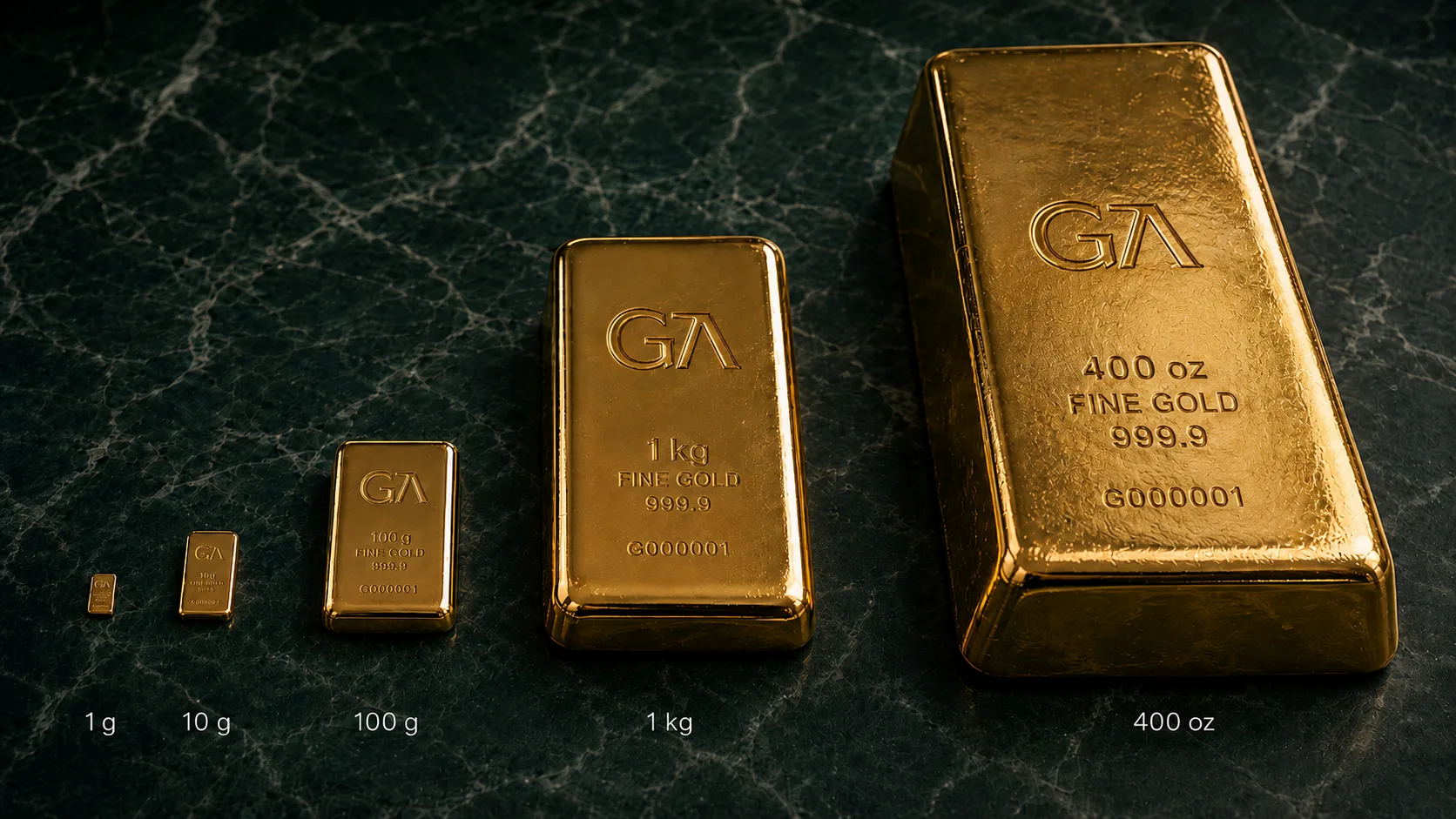
How much does a gold bar weigh? It depends on the format: gold bars range from one-gram bars up to wholesale bars that run past twelve kilograms. Two things keep the answer from being a single number. Gold is weighed in troy ounces, which are heavier than the standard ounce, so a weight given in ounces will not convert at the rate most calculations assume; and on a large bar, a figure such as “400 oz” refers to a standard range rather than an exact mass. This page works through each format in turn — gram and one-ounce bars, the kilobar, and the 100- and 400-ounce bars — giving each weight in grams, kilograms, and troy ounces, and the reason the wholesale sizes settle where they do.
Troy ounces, grams, and the ordinary ounce
Gold trades by the troy ounce, a unit distinct from the avoirdupois ounce used for most goods. One troy ounce is 31.1035 grams; the everyday ounce is 28.35 grams. The two differ by close to ten percent, and the gap does not announce itself — both are written “oz.” A weight quoted in ounces therefore has to be confirmed as troy before it converts to grams or feeds a value calculation, or the result overstates the gold by roughly a tenth.
Worked through a kilobar: 1,000 grams is 32.15 troy ounces, while the same mass divided by the avoirdupois figure reads 35.27 — an apparent three extra ounces of gold. On a single bar the discrepancy is a rounding nuisance; across a multi-bar position it compounds into a real misstatement of holdings and invoice value.
To strip the ambiguity out, refiners stamp metric weights on smaller bars, and bar lists are frequently kept in grams. The troy ounce stays the pricing unit, so both systems run in parallel: the bar is weighed and recorded in grams, the trade is priced and invoiced per troy ounce, and the conversion between them uses 31.1035 — not 28.35.
Fine weight versus gross weight
A gold bar carries two weights, and the difference governs what a buyer pays. Gross weight is the total mass on the scale. Fine weight is the quantity of pure gold in the bar, equal to the gross weight multiplied by the bar’s fineness — the proportion of pure gold, in parts per thousand. The trade is invoiced on fine weight: the buyer pays for the gold content the bar carries.
On high-purity investment bars the two weights nearly coincide. A one-ounce bar refined to 999.9 fineness — “four nines,” the common standard for minted bars — is 99.99 percent gold, so its gross and fine weights are identical to any figure that matters in practice. The gap opens on bars produced to a lower minimum. An LBMA Good Delivery bar need only assay to 995.0 fineness, so its gold content sits below its gross mass: a bar of 1,000 grams gross at 995.0 fineness holds 995 grams of pure gold, and at the wholesale scale a bar recorded near 402 troy ounces gross contains close to 400 fine troy ounces. The invoice follows the fine figure in both cases.
A bar’s specifications list gross weight and fineness as separate fields for this reason, and the gold content — the product of the two — is what ties out to value. Two bars of identical gross weight but different fineness hold different quantities of gold and are invoiced at different amounts. Reconciling a position means tracking fine ounces; the gross mass enters the calculation as the base that fineness multiplies.
Standard bar formats by weight
Across refiners, the formats are standard: a 100-gram bar from one refiner weighs the same as a 100-gram bar from another. The table lists the common formats in grams and troy ounces, with kilograms for the larger bars. Smaller bars are typically minted, struck from a blank to a precise weight; larger bars are cast, poured into a mould, a process with a wider weight tolerance that becomes material at wholesale scale.
| Format | Grams | Troy ounces |
|---|---|---|
| 1 g | 1 | 0.032 |
| 5 g | 5 | 0.161 |
| 10 g | 10 | 0.321 |
| 20 g | 20 | 0.643 |
| 1 oz | 31.10 | 1 |
| 50 g | 50 | 1.608 |
| 100 g | 100 | 3.215 |
| 250 g | 250 | 8.038 |
| 500 g | 500 | 16.075 |
| 1 kg (kilobar) | 1,000 | 32.151 |
| 100 oz | 3,110 (3.11 kg) | 100 |
| 400 oz (Good Delivery) | ~12,400–12,500 (~12.4–12.5 kg) | 350–430 fine (≈400) |
Golden Ark Reserve sources these as refinery-origin bars from Heraeus and Argor-Heraeus, set out by weight and specification across its gold bar formats. Read as a set, the table is a choice of denomination: a given holding can be assembled from many small serial numbers or a few large ones, and that split decides how the position later divides for delivery or partial sale.
Why the institutional formats weigh what they weigh
COMEX gold futures settle in physical metal as either one 100-ounce bar or three one-kilogram bars, each assaying to a minimum of 995 fineness, and the exchange’s enhanced-delivery contract adds the 400-ounce bar; the London wholesale market is built on the 400-ounce Good Delivery bar. These delivery standards are why the kilobar and the 400-ounce bar recur across institutional holdings: a bar that meets a deliverable weight-and-fineness specification is fungible within its market — deliverable against a contract or movable between vaults without re-assay. The institutional weights are the ones the standards admit.
The kilobar (1 kg)
In Asian markets and in allocated storage, the working unit below the wholesale bars is the kilobar. Its weight is exact: one kilogram — 1,000 grams, or 32.151 troy ounces — and most kilobars are refined to 999.9 fineness, so fine and gross weight coincide. Golden Ark Reserve sources 1 kg gold bars from both of its refinery anchors — Argor-Heraeus casts gold bars up to the one-kilogram format, with larger cast sizes produced by Heraeus — and the exactness carries through to position-keeping: holdings scale in clean one-kilogram increments, and a hundred kilograms is a hundred individually serial-numbered bars.
The 400-ounce Good Delivery bar
Under the LBMA Good Delivery rules — the specification governing bars accepted in the London market — “400 ounces” names a tolerance band: a conforming bar contains between 350 and 430 fine troy ounces of gold, with most produced close to 400, for a total mass of roughly 12.4 to 12.5 kilograms. Each bar’s gold content sits somewhere in that band, so its gross weight is measured and recorded individually, expressed in troy ounces in multiples of 0.025, and the bar settles on its own recorded fine weight. Heraeus produces the format to Good Delivery standard at the minimum 995 fineness the rules require, and 400 oz gold bars sit at the large-lot end of Golden Ark Reserve’s range — the one format here whose exact weight exists only as the figure recorded against its serial number.
What bar weight changes operationally
After the purchase closes, the weight keeps working: the same figure feeds the invoice check and the delivery plan, then follows the bar into its custody record. An error in the number — or in its unit — travels with it.
Value settles on fine weight. Gold is quoted per troy ounce, so a holding is worth its fine troy ounces multiplied by the per-ounce price. A position recorded in grams converts at 31.1035 before any per-ounce gold spot price applies; a kilobar at 999.9 fineness contributes 32.15 fine ounces, while two Good Delivery bars both labelled 400 ounces contribute their individually recorded fine weights and invoice at different amounts. Checking an invoice or marking a position to market means applying the quoted price to fine ounces, with the weight confirmed in troy units.
Moving the metal turns weight physical: the mass of each bar and the number of bars set packing, carrier capacity, insured value per package, and the point at which risk transfers under the shipment’s Incoterms. A single Good Delivery bar concentrates roughly twelve and a half kilograms of value in one indivisible unit that cannot be split to satisfy a partial movement; the same value held in kilobars spreads across many serial-numbered units that can be allocated and shipped in part. Movement coordinated through Brink’s is specified bar by bar, against the recorded weights.
On allocated holdings, the recorded weight identifies a bar over its life. Each bar is logged by serial number with its gross and fine weight, and that record ties the specific bar to its owner. Custody confirmation reconciles against the recorded figures, and so do audit and eventual resale: a depository verifies the weight inscribed on the bar against the bar list, and a gap between recorded and physical weight is a reconciliation break — resolved as one, however small. Golden Ark Reserve carries each bar’s weight and serial number into the Allocation Record and Evidence Set issued to the holder, so the figure that priced the purchase continues to evidence ownership through storage and exit.