

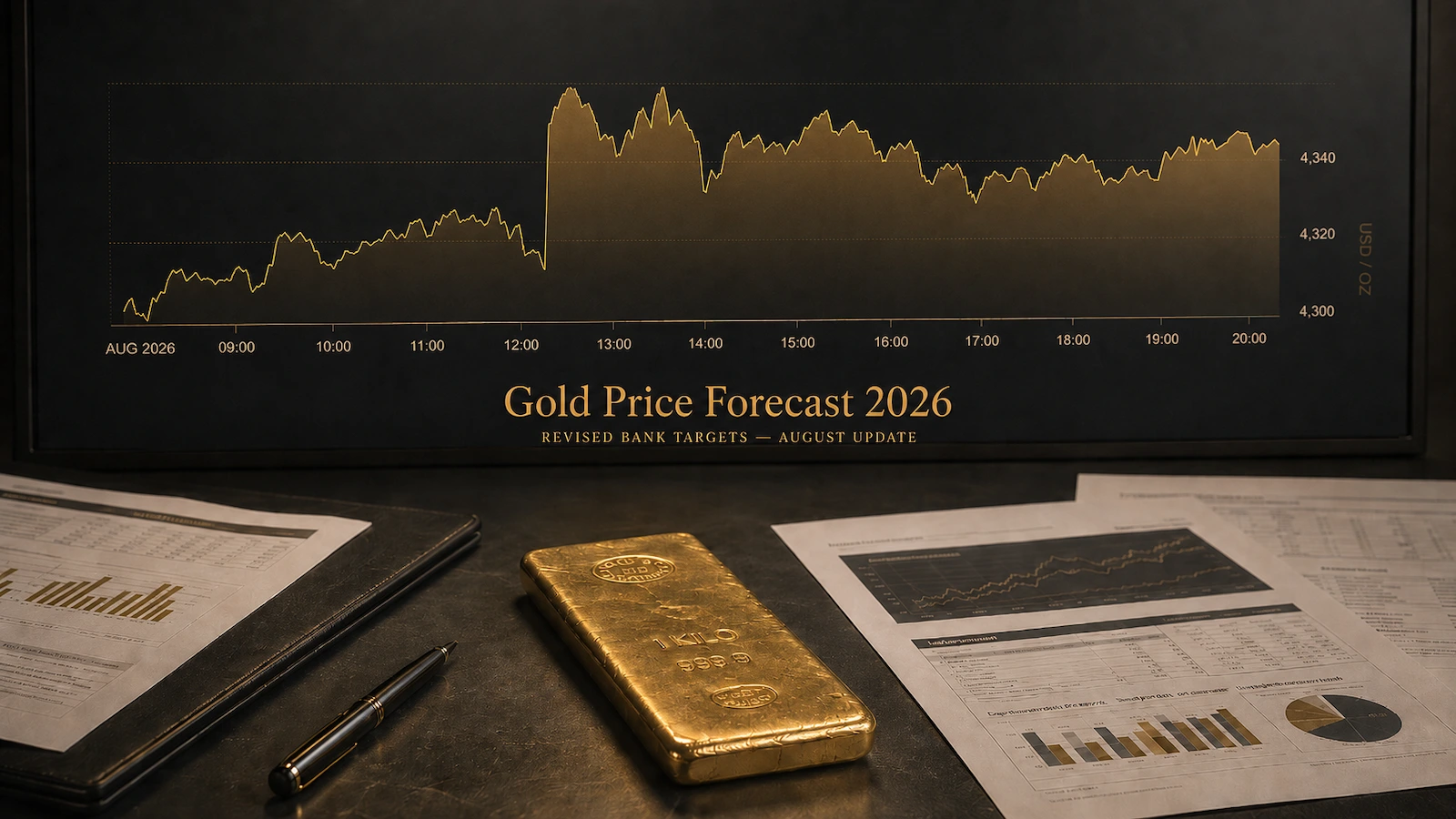
This year, the date on a gold price forecast matters as much as the number in it. Between early June and mid-July 2026, four major banks — Goldman Sachs, JPMorgan, HSBC and Citi — revised their published gold targets; at one of them, the year-end level moved by $1,500 an ounce between two notes. A set of targets that spanned roughly $4,800–6,300 in June now splits in two: a revised camp around $4,000–5,200, and an unrevised camp still holding $5,000–6,300, with spot back above $4,300 after its strongest week since January. This page records the post-revision state as of early August — each level dated to its note, the unchanged calls marked as unchanged — while the June edition of this forecast maps the 2026–2027 targets as they were before the cuts.
Where the forecast field stands in August
Spot gold closed the week of 7 August 2026 at $4,343 an ounce — up nearly $300 from the $4,050 area of 3 August, after the July jobs report — the level every target below is read against. Figures on this page are indicative reference prices — delayed, rounded and aggregated from third-party market data; none is an executable quotation.
The June–July revisions, desk by desk:
| Forecaster | Prior published level (USD/oz) | Current level (USD/oz) | Revised |
|---|---|---|---|
| Goldman Sachs (US) | 5,400 end-2026, held since January | 4,900 end-2026 | 19 June |
| JPMorgan (US) | ~6,000 Q4 2026, note of 9 June | 4,300 Q3 average; 4,500 Q4 | 3 July |
| HSBC (UK) | 4,864 average 2026 | 4,560 average 2026; year-end 4,750 held | 9 July |
| Citi (US) | 4,300 short-horizon | 4,000 short-horizon | 9 June |
Among the four, year-end 2026 levels now run $4,500–4,900, with Citi’s $4,000 beneath them on a shorter horizon. UBS sits at the top of the revised span: having trimmed its end-2026 figure to $5,500 in May, the bank now puts its 12-month level at $5,200 on the view that dollar strength fades and the Fed leaves rates where they are. Set against the $4,800–6,300 year-end band the June edition recorded, the revised field sits both lower and wider: the floor has come down $800, the ceiling of the revised camp stops $1,100 short of June’s top, and the midpoints of the two camps sit more than $1,000 apart.
What changed between June and August
Citi opened the sequence on 9 June, moving its short-horizon marker from $4,300 to $4,000. Goldman Sachs followed on 19 June: analysts Lina Thomas and Daan Struyven cut the year-end level from $5,400 to $4,900 because the bank no longer expects the Federal Reserve to cut rates at all in 2026, with the first easing pushed to June 2027. Two qualifiers frame the cut. On the downside, Goldman’s analysts noted that an actual Fed hike could carry gold to $4,400 by year-end; on the upside, they kept central-bank diversification as the structural driver — purchases running about 50 tonnes a month, well above pre-2022 levels.
Of the four revisions, JPMorgan’s on 3 July was the largest and the source of the $1,500 gap in the opening: the desk cut its Q4 2026 level by 25% to $4,500, from the $6,000 path issued just 24 days earlier, and set $4,300 as the Q3 average. The stated grounds, per the Reuters wire, pair softer demand with rate risk: buying from key sectors runs weaker than the bank expected, and possible early Fed hikes on hot summer data would skew its numbers lower still — while the longer-horizon case, built on official-sector buying and physical demand, is intact.
HSBC’s 9 July note has the least dramatic headline and the most useful signal. Chief precious metals analyst James Steel cut the 2026 average to $4,560 from $4,864 and the 2027 average to $4,925 from $5,000 — and left the year-end markers untouched: $4,750 for 2026, $5,025 for 2027, with 2028–2029 held at $5,200 and $5,300. The bank now expects a $3,800–4,700 trading range through the rest of 2026, closing the year near $4,750. Read together, the cut lands on the path, and the destination stands.
Predating the wave, two consensus markers now serve as its baseline: the LBMA analyst survey averaging $4,742 and a Reuters poll of 31 analysts with a 2026 median near $4,916 were both collected before the June–July notes. Until the next quarterly rounds print, each functions as a pre-revision benchmark — a reading of where the field stood, dated to a field that no longer exists.
What held: the unrevised camp
While the revising desks moved, Wells Fargo Investment Institute kept $6,100–6,300 for year-end 2026 — raised earlier in the year from $4,500–4,700 — with no revision reported through the June–July wave. Bank of America’s $6,000 comes in an unusual configuration. Commodity strategist Michael Widmer, the number’s author, has called the level unlikely for now, yet an extreme-demand scenario of $8,000 by 2027 stays on the table. The bank’s rates research shows a late-June base case of three Fed hikes in 2026. One institution now pairs the second-highest gold target in this comparison with the most hawkish rate path. State Street Global Advisors’ July Monthly Gold Monitor takes the middle ground. Its base case runs $5,000 into early 2027, inside a 70%-probability band of $4,750–5,500, and the bank reads the drawdown as tactical positioning against an intact structural case.
Morgan Stanley and Deutsche Bank appear across press reports at levels that conflict between sources; both are omitted here pending primary confirmation. What remains spans $4,000 to $6,300 across the two camps — against June’s $4,800–6,300 band, the floor has moved down and the ceiling has held. June’s forecasters agreed on direction and divided on magnitude. August’s forecasters divide on direction as well: Citi’s near-term $4,000 is more than $340 below the 7 August close.
The rate path behind the revisions
Every revising note cites the same variable — the policy outlook repriced. Higher energy costs fed headline inflation to 4.2% in May; Kevin Warsh used his debut press conference as Fed Chair to signal no tolerance for high inflation; Cleveland Fed’s Beth Hammack saw little evidence current rates restrain the economy; by quarter-end, futures put September-hike odds near 64%. June’s CPI print — 3.5%, with a 0.4% monthly fall that was the largest since April 2020 — then pulled those odds back toward even. The 29 July FOMC then left the 3.50–3.75% range in place on a divided 9–3 vote, with three members preferring a quarter-point increase — a split the market read hawkishly, pricing September-hike odds back up to almost 58%. By 3 August oil had eased, the dollar sat at its lowest since mid-June, and spot recovered above $4,050 intraday. The July payrolls report broke the sequence open on 7 August: payrolls fell 23,000 against an expected 83,000 gain, May and June were revised down by a combined 103,000, wage growth slowed to 3.2% year on year — the lowest since May 2021 — and September-hike odds collapsed to about 44% from that 58%, with spot ending its strongest week since January above $4,340. The revisions encode the hawkish leg of that swing: Goldman’s cut removes 2026 easing entirely, JPMorgan’s quantifies the yield sensitivity, HSBC’s narrows the trading range with the destination unchanged. The session-level mechanics behind the swing — price action, policy, flows — are treated in the August market analysis.
Demand data under the targets
Underneath every target, revised or unrevised, lies the same demand assumption: the official sector keeps buying, and physical channels absorb what funds sell. The World Gold Council’s Q2 accounting, published 30 July, prices that assumption. Total demand held flat year on year at 1,269 tonnes, and first-half demand ran 2% higher at a record $380 billion in value. Composition did the moving: gold-backed ETFs shed 45 tonnes over the quarter, while over-the-counter demand ran to 327 tonnes — 571 across the half — through Asian institutional channels.
The official-sector line reads two ways. Net reported purchases thinned to about 16 tonnes in Q1 before May restored a 41-tonne net month — China’s 10-tonne addition its largest since December 2024 — and the Council expects the year to finish strong but below the 2025 total; the case for treating that demand as a reserve-asset foundation is set out in gold as a strategic reserve asset. Goldman’s cut note retains central-bank buying of about 50 tonnes a month as the structural support under its $4,900 — the floor assumption, in one number.
The 2027 horizon after the cuts
The 2027 numbers moved less than the 2026 ones, and that asymmetry is the read. HSBC trimmed its 2027 average to $4,925 while leaving the year-end marker at $5,025, with 2028–2029 left at $5,200 and $5,300; Goldman’s revised path starts easing in June 2027, which places its $4,900 as a trough on the way to its 2027 grind higher. UBS’s 12-month $5,200 lands in mid-2027; State Street’s $5,000 base case runs into early 2027. June had Commerzbank near $5,200 into 2027 and JPMorgan at $6,300 as a 2027 possibility; the July revision reset JPMorgan’s near-term levels without a published 2027 replacement in press reporting. One outlier remains on record: Bank of America’s extreme-demand scenario of $8,000 by 2027. Across the forecasters, revised 2027 levels cluster near $4,925–5,200 — a tighter span than 2026’s — with the unrevised tail stretching to $8,000. Desks cut the path through 2026 and largely kept the destination beyond it.
Reading a dated forecast
As of the 7 August close, the state of the forecasts reads in two lines. Revised year-end levels run $4,000–4,900, with UBS’s $5,200 above them on a 12-month horizon. The unrevised camp keeps $5,000–6,300, and 2027 estimates cluster near $4,925–5,200 — while spot, at $4,343, is back above the revised camp’s floor within a month of the cuts. The levels here are third-party research reproduced as dated reference: Golden Ark Reserve publishes no price forecast of its own, endorses none of them, and nothing on this page is investment advice or a recommendation. Pricing on a defined lot is separate from any forecast — a proposal on specific bars runs through physical gold purchase and is priced by executable quote at contract.
Four scheduled prints will re-date this page. The 12 August CPI release tests whether the jobs-driven repricing sticks; the next LBMA and Reuters quarterly polls replace the pre-revision benchmarks; the 16 September FOMC meeting resolves hike odds now near 44%; each desk’s next note replaces its row above. Then the rule. A level quoted in an internal document works only with two attachments: the note date and the horizon.
Sources
- Goldman Sachs year-end revision, 19 June 2026 — end-2026 to $4,900 from $5,400; expected Fed cuts moved to June and December 2027; hike scenario at $4,400 (Bloomberg wire via Yahoo Finance); central-bank floor of about 50 tonnes a month per the note, via Benzinga.
- JPMorgan Q3/Q4 revision, 3 July 2026 — $4,300 Q3 average and $4,500 Q4, replacing the $6,000 path issued 9 June; weaker key-sector demand cited, risks flagged to the downside (Reuters wire, 3 July; primary note not publicly available).
- HSBC forecast revision, 9 July 2026 — 2026 average to $4,560 and 2027 average to $4,925; year-end markers $4,750 / $5,025 held, 2028–2029 at $5,200 / $5,300; $3,800–4,700 trading range (Reuters wire, 9 July).
- World Gold Council — Gold Demand Trends Q2 2026 (30 July 2026) — Q2 and H1 demand totals, ETF outflows, OTC volumes, official-sector view.
- Trading Economics — Gold (accessed 3–8 August 2026) — 3 August level; 7 August intraday above $4,350, a two-month high.
- US Bureau of Labor Statistics, July 2026 Employment Situation — via CNBC (7 August 2026) — payrolls −23,000 against +83,000 expected; May–June revised down a combined 103,000; earnings +3.2% year on year; participation 61.4%; the 29 July FOMC 9–3 hold at 3.50–3.75%.
- CME FedWatch repricing — via CNBC (7 August 2026) — September-hike odds to about 44% from 58% after the jobs report.
- Kitco News — gold reaction to the July jobs report (7 August 2026).
- State Street Global Advisors, Monthly Gold Monitor, July 2026 — $5,000 base case into early 2027 inside a 70% band of $4,750–5,500, as carried in market press.
- Citi (9 June), UBS, Wells Fargo Investment Institute and Bank of America positions; LBMA analyst survey; Reuters poll of 31 analysts (2026 median near $4,916) — client research and survey publications, as carried in financial press, May–July 2026.
- Federal Reserve communications — Chair Warsh’s debut press conference; Cleveland Fed President Hammack’s comments — public record via press coverage, June–July 2026.
- US CPI prints (May, June 2026) — Bureau of Labor Statistics data as carried in market reporting.