

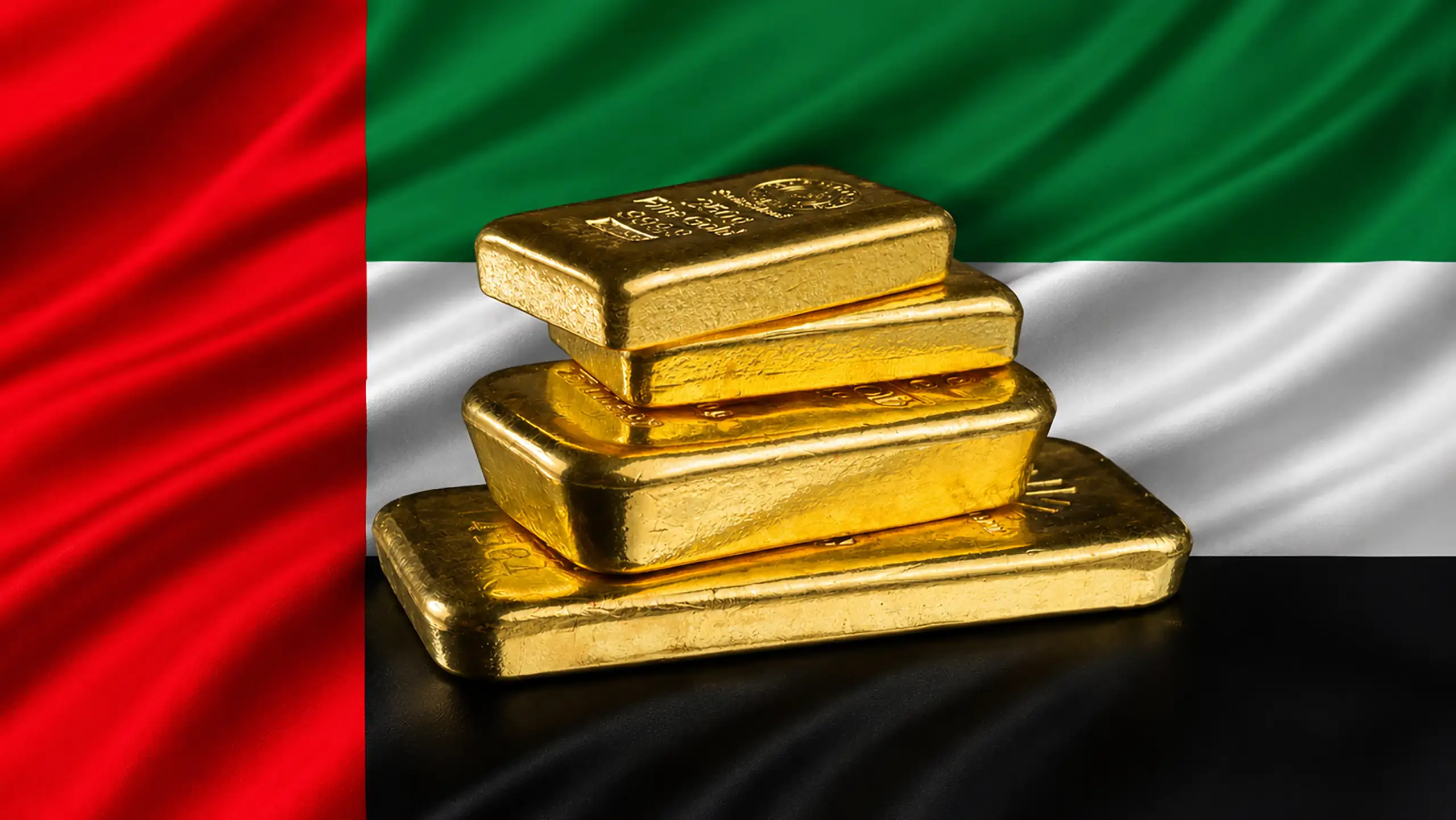
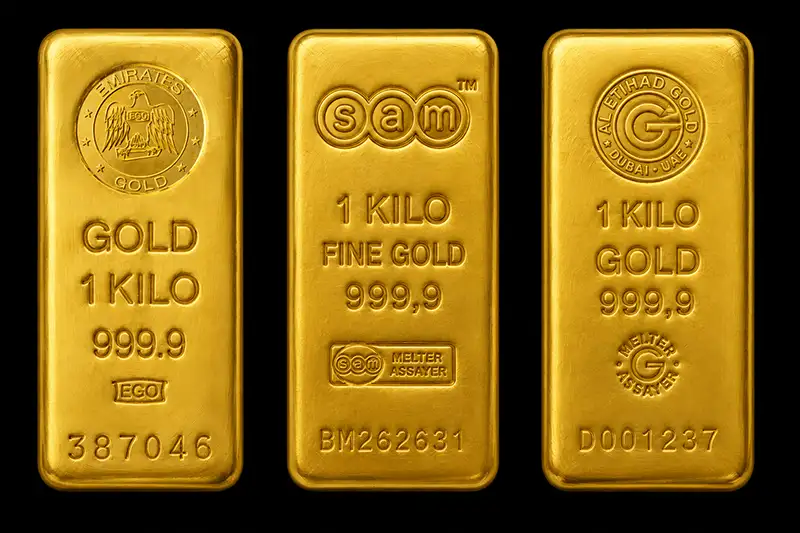
UAE refineries cast and mint several hundred tonnes of gold bullion each year. Six producers carry meaningful commercial weight in the sector. Three operate under current UAE Good Delivery (UAEGD) accreditation — Al Etihad Gold Refinery DMCC, Emirates Gold DMCC, and SAM Precious Metals FZ-LLC. Three further producers stand outside that perimeter: Kaloti Precious Metals, MTM&O Gold Refinery DMCC, and International Precious Metal Refiners LLC. Output across these six refineries spans cast and minted bars at 995 and 999.9 fineness, in formats from 400 oz wholesale stock through 1 kg kilobars and ten-tola export bars to sub-kilo investment ranges and mint-blank product for sovereign and private mints.
How UAE refining took shape
Through most of the twentieth century the country’s gold business ran through the Deira Gold Souk — a market that grew from the 1940s onward as Iranian and Indian merchants established Dubai as a regional bullion trading point, and that scaled sharply after the discovery of oil in the late 1960s and the federation of the United Arab Emirates in 1971. Trading came first by several decades. Refining capacity at industrial scale arrived in the 1990s and 2000s.
Emirates Gold opened the modern era. The refinery was founded in 1992 by Mohamad Shakarchi, a Swiss-Lebanese precious-metals entrepreneur, and through the 1990s it built into one of the larger gold refining operations in the region. In 2005 the Dubai Multi Commodities Centre established the Dubai Good Delivery (DGD) standard — the first local Good Delivery framework for gold accreditation. Emirates Gold received its accreditation on 20 September of that year, the earliest UAE-based refiner on the list. Al Etihad Gold Refinery followed under DGD in December 2012, and the Kaloti Group’s Sharjah refinery operated under DGD accreditation through this period. Across the 2010s the country’s refining footprint expanded to roughly ten active gold refineries concentrated in the DMCC Free Zone in Jumeirah Lakes Towers and in adjacent zones in Sharjah.
In November 2021 the DGD framework was nationally replaced by the UAE Good Delivery (UAEGD) standard, governed by the Emirates Bullion Market Committee with DMCC continuing as the on-ground accreditation administrator. The transition raised the standard from a Dubai-specific framework to a federal one. New requirements aligned responsible-sourcing rules with the OECD Due Diligence Guidance and mandated annual third-party assurance reviews under approved providers. Underneath the voluntary UAEGD layer runs the mandatory federal floor. The UAE Ministry of Economy issued the Federal Due Diligence Regulations for Responsible Sourcing of Gold in January 2023, applying to every refiner, recycler, and gold-trade operator on UAE territory regardless of UAEGD status. Ministerial Decree No. 68 of 2024 expanded the framework further. In parallel, the country’s broader anti-money-laundering posture went through the FATF grey-list cycle — UAE entered the list in March 2022 and exited in February 2024 after working through a structural action plan that included reforms to the precious-metals sector.
Today the sector operates under three concurrent regulatory layers: voluntary UAEGD accreditation, mandatory federal Due Diligence Regulations, and the documented audit cycles flowing from both. Each of the six refineries below sits at a different intersection of these layers.
UAE gold refineries: producer profiles
The six refineries below carry the commercial weight of the UAE gold refining sector. The first three — Al Etihad Gold Refinery DMCC, Emirates Gold DMCC, and SAM Precious Metals FZ-LLC — operate under current UAEGD accreditation, with their bars recognised under the national Good Delivery standard and accepted into the Indian wholesale corridor at the 1 kg kilobar format under preferential CEPA duty. The remaining three — Kaloti Precious Metals, MTM&O Gold Refinery DMCC, and International Precious Metal Refiners LLC — operate outside the UAEGD perimeter, each for its own combination of historical, structural, and compliance reasons covered in the relevant profile.
Al Etihad Gold Refinery DMCC
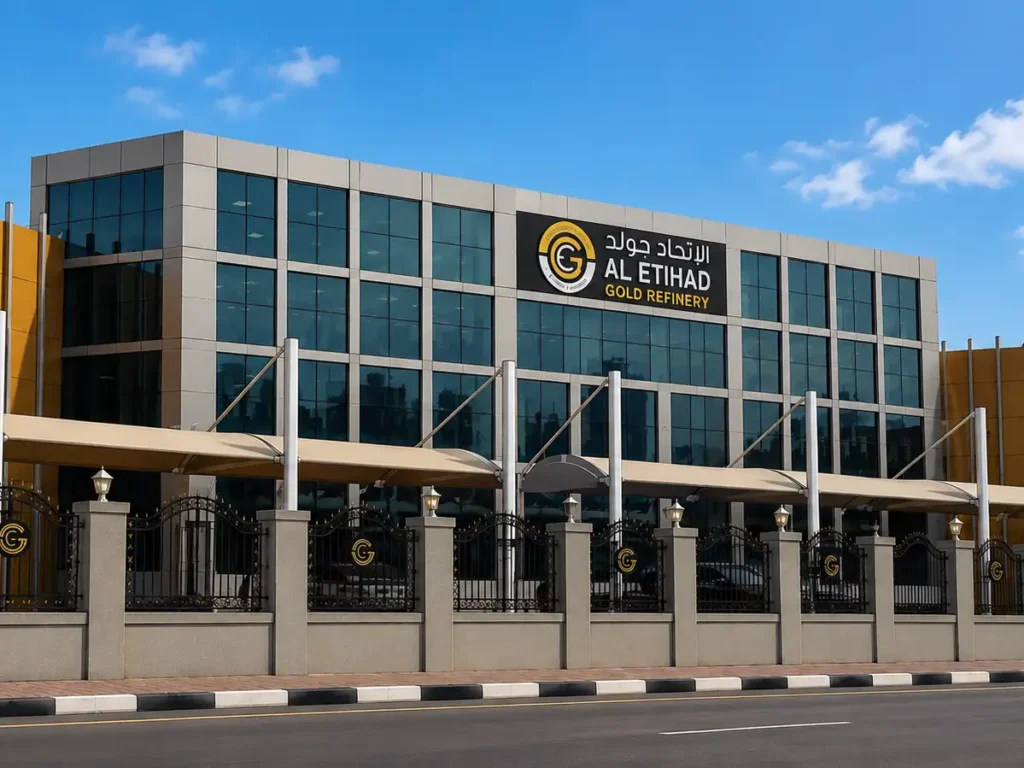
In 2022 the India-UAE Comprehensive Economic Partnership Agreement established a 1% duty differential on UAEGD-marked gold bars entering India, capped at 150 tonnes annually within the gold quota. Al Etihad Gold Refinery DMCC has built capacity oriented toward this corridor — kilobar production at 995 and 999.9 fineness, ten-tola bars at 999.0 fineness sized for South Asian markets, and a broad minted bar range — alongside regional fabrication supply across the GCC.
Operating from the DMCC Free Zone in Jumeirah Lakes Towers, Al Etihad has held UAEGD accreditation continuously since 16 December 2012 — the longest unbroken record on the active list among UAE-based refiners, through the period that included the Kaloti delisting in 2015, the FATF grey-list cycle, and the Emirates Gold suspension in 2023. Annual responsible-sourcing assurance reviews have run through Bureau Veritas and DMCC’s own protocol, with public reports filed under the OECD Due Diligence Guidance. Beyond the Good Delivery framework, the refinery holds ISO 9001:2015, ISO 14001:2015, and ISO 45001:2018 certifications, and is a Certified Member of the Responsible Jewellery Council.
Doré, recycled gold, and scrap feed the chemical refining lines. Annual capacity reaches several hundred tonnes. That places Al Etihad among the larger single-refinery operations in the region.
Product output across formats:
| Format | Fineness | Use |
|---|---|---|
| 400 oz cast bar | 995 | International wholesale |
| 1 kg cast bar | 995 / 999.9 | Institutional, Indian wholesale corridor |
| 10 tola (116.64 g) | 999.0 | South Asian markets |
| 100 g, 50 g, 20 g, 10 g, 5 g, 2.5 g, 1 g minted | 999.9 | Assay-card investment, retail distribution |
| Mint-blank stock | On specification | Sovereign and private mint customers |
From the chemical refining lines through UAEGD-marked kilobars and the full minted-bar range, daily output feeds the Indian wholesale corridor under CEPA preferential entry alongside regional fabrication supply across the GCC.
Emirates Gold DMCC

Emirates Gold DMCC operates from the DMCC Free Zone in Jumeirah Lakes Towers and is one of the largest gold refining operations in the UAE by historical output volume. The refinery was founded in 1992 by Mohamad Shakarchi, a Swiss-Lebanese precious-metals entrepreneur whose family had operated in the Swiss bullion market through the Shakarchi Trading group, and built into a major regional refining presence through the 1990s and 2000s. Emirates Gold received its Dubai Good Delivery accreditation on 20 September 2005 — the first UAE-based refiner on the local Good Delivery list — and the accreditation rolled into the UAEGD framework when DGD was nationally replaced in November 2021. Annual responsible-sourcing assurance reviews ran through Ernst & Young across multiple cycles. By the early 2020s the refinery reported processing capacity in the range of several hundred tonnes of gold annually.
The 2021–2024 period reshaped the refinery materially. Mohamad Shakarchi died in 2021, and in 2022 Emirates Gold underwent an ownership transition out of the Shakarchi family. On 14 July 2023, the Emirates Bullion Market Committee suspended Emirates Gold’s UAEGD accreditation, and the LBMA followed within days by suspending the refinery’s Affiliate Membership — citing its own due-diligence review. Bloomberg, Reuters, and the regional precious-metals press reported the suspensions as the most prominent enforcement action against a UAE-based refiner since the Kaloti delisting eight years earlier. Emirates Gold issued a public statement that the suspensions did not constitute loss of trading licence, that the company had passed recent compliance audits, and that management was working with the Emirates Bullion Market Committee toward reinstatement. Under new ownership reported as Bright East Holding 1, the refinery’s UAEGD accreditation was subsequently restored against the post-2024 audit cycle, and operations have continued under the renewed accreditation since.
Product range:
- 1 kg cast bars, 995 and 999.9 fineness — institutional allocation and wholesale supply
- 100 g, 50 g, 10 g, 5 g, 1 g minted bars, 999.9 fineness — branded “Emirates Gold” assay cards
- Coin blanks for sovereign and private mints — on specification, custom production runs
- Custom commemorative and bullion coin production for mint customers
- Cast bars in non-standard weights for institutional and industrial buyers
Compliance review of Emirates Gold today turns on a documented sequence: the 2022 ownership transition out of the Shakarchi family, followed by the July 2023 suspension and the subsequent reinstatement under Bright East Holding 1 against the post-2024 audit cycle. Any institutional compliance review draws on the post-2024 documentation set; pre-2023 events serve as background context.
By the post-2024 audit cycle, production runs on against the renewed UAEGD baseline — kilobars at 995 and 999.9 fineness, sub-kilo minted formats, and coin-blank stock for sovereign and private mint customers.
SAM Precious Metals FZ-LLC

Operating from the DMCC Free Zone with ties to Cairo’s Egyptian gold and jewellery trade, SAM Precious Metals FZ-LLC holds current UAEGD accreditation across both gold and silver — the third active UAE-based member alongside Al Etihad and Emirates Gold. Chemical and electrolytic refining lines process doré, recycled gold, and scrap input streams, with operational emphasis on traceability through the refining cycle and on full recovery from input material.
Within the UAEGD active-member group, the SAM output range covers 1 kg cast bars at 995 and 999.9 fineness, 100 g and 50 g cast and minted bars, 10 g and 5 g minted bars in assay-card packaging, and the silver companion range. SAM also runs toll-refining for institutional gold producers. The route opens access to UAEGD-marked output without operating dedicated refining lines.
At smaller scale than Al Etihad or Emirates Gold, and with brand presence in regional B2B keyword searches at an order of magnitude below the larger two, SAM holds capability across both gold and silver under UAEGD accreditation. Toll-refining channels third-party doré and scrap into accredited bars for producers without dedicated refining lines.
Kaloti Precious Metals
The Kaloti Precious Metals operation is the historical operating umbrella under which the Kaloti family built its UAE gold business across the past five decades, and remains one of the most commercially recognisable names in the regional precious-metals sector. Munir Al-Kaloti, the group’s founder, began trading gold in Abu Dhabi in 1968 and moved to Dubai in 1976, where he traded out of the Deira Gold Souk through the late 1980s before scaling into bullion through the 1990s and 2000s. The group’s main DMCC entity, Kaloti Jewellery International DMCC, was established in 2004, and the group operated the Kaloti Jewellery Factory in Sharjah as its primary refining operation through the early 2010s.
The 2013–2015 period generated the central documented compliance episode in the UAE gold sector. EY conducted a 2013 responsible-sourcing audit of the Kaloti Sharjah refinery commissioned by DMCC. Amjad Rihan, EY’s engagement partner on the audit, identified what he characterised as zero-tolerance breaches under DMCC’s own guidelines — the central finding being import of gold bars coated in silver from Morocco, which Rihan characterised as a method to circumvent export controls. The handling of the audit findings became the subject of subsequent legal proceedings: in a 2020 judgment, Justice Kerr of the London High Court ruled in favour of Rihan in a whistleblower claim against EY, with the judgment reaching a damages award of approximately USD 11 million on appeal and finding that the audit findings had been managed in a way that delayed external escalation. In April 2015, DMCC removed Kaloti’s Sharjah refinery from the Dubai Good Delivery Gold Members list, citing failure to meet DMCC’s practical guidance for market participants in the gold and precious-metals industry without specifying the underlying breaches publicly. The Sharjah refinery subsequently closed.
Operations continued under the broader Kaloti group structure. The group’s commercial activity in Dubai has continued as a non-UAEGD-accredited operation under the federal due-diligence regime applicable to all UAE refiners and traders. ICIJ FinCEN Files reporting (2020) and Pulitzer Center / DIE ZEIT investigations (2024) have documented continued international trading activity and references to ongoing investigations at various jurisdictional levels; Kaloti has consistently denied the allegations and has stated that the company’s business has evolved to comply with regulatory changes and consistently meets or exceeds applicable requirements.
Product range (historical Sharjah refinery output, prior to April 2015 closure):
- 1 kg cast bars, 995 and 999.9 fineness — institutional and wholesale
- 100 g, 50 g, 10 g, 5 g, 1 g minted bars, 999.9 fineness — branded assay cards
- Ten-tola bars (116.64 g), 999.0 fineness — South Asian markets
- Doré refining and bullion services — institutional input streams
- Jewellery and trade-grade gold products through the broader group
The broader Kaloti group runs ongoing operations across precious-metals trading and jewellery in the region, with the Kaloti tower in DMCC standing as a landmark building. The specific Sharjah refining capacity that operated under DGD accreditation through the early 2010s closed in April 2015 and has not been reconstituted. Refined-gold bullion output from a Kaloti-owned Sharjah line ended at that point.
MTM&O Gold Refinery DMCC
In February 2017, two years after the Kaloti Sharjah refinery’s DGD delisting and closure, MTM&O Gold Refinery DMCC was incorporated in the same DMCC Free Zone — at Unit G-01, “Kaloti”, Plot DMCC-EZ3-01A, physically inside the Kaloti tower. The CEO is Osama M. al-Kaloti, of the Kaloti family. Pulitzer Center and DIE ZEIT investigative reporting (2024) characterises MTM&O as the operational continuation of the refining business after the 2015 closure, and Global Witness reporting cited by ICIJ records the establishment of MTM&O as a successor operation to the prior DGD-accredited Kaloti capacity.
According to the company’s primary website at mtm-o.com, operations cover gold and silver smelting, refining, and kilobar and bullion production using robotised production technology. Output covers 1 kg cast bars at 995 and 999.9 fineness on the kilobar production line, 100 g, 50 g, and 10 g minted formats at 999.9 fineness, 5 g and 1 g minted bars for retail distribution, silver bars and ingots as a companion range, and doré refining and bullion processing for trade counterparties.
MTM&O has not held UAEGD accreditation. Operations run under the federal Due Diligence Regulations as the mandatory framework — applicable regardless of voluntary Good Delivery standing. International supply-chain reporting has documented MTM&O’s gold sales to Valcambi between 2016 and 2020; Valcambi confirmed undergoing two LBMA audits in that period, including a special audit specifically required because the company had received recycled gold from the UAE during a high-risk-jurisdiction period.
In the public documentary record, the 2017 incorporation and the Kaloti-tower address establish the corporate footprint. Osama M. al-Kaloti as CEO confirms the family link. Pulitzer Center, DIE ZEIT, and Global Witness reporting characterise the operation as a successor to the prior Kaloti refining capacity. UAEGD accreditation is not held; Federal Due Diligence Regulations apply as the only regulatory framework.
International Precious Metal Refiners LLC (IPMR)
From Sharjah, the second UAE emirate hosting active gold refining capacity alongside Dubai, International Precious Metal Refiners LLC (IPMR) operates under the emirate’s free-zone framework with federal-level oversight. IPMR received Dubai Good Delivery accreditation on 1 April 2019 — relatively late in the DGD lifecycle, which the UAEGD framework nationally replaced in November 2021. As of the 2022 LBMA Spotlight on the UAE record, the three UAE-based active UAEGD members were Al Etihad, Emirates Gold, and SAM Precious Metals. IPMR was not among them.
Diamond and gold separation distinguishes the technical profile within the UAE refining sector — a capability operationally relevant for input streams from jewellery scrap and from doré with mixed precious-metal content, where conventional gold-only refining lines cannot recover both metals. Public materials describe IPMR as a connection point between gold producers and the major consuming markets of the Indian subcontinent, the Middle East, and Asia, with operational location in the UAE positioned as a structural advantage for that intermediation role.
Inputs and outputs:
| Input streams | Output formats |
|---|---|
| Doré (single-content gold) | 1 kg cast bars, 995 fineness — wholesale and institutional |
| Recycled gold and scrap | 1 kg cast bars, 999.9 fineness — investment grade |
| Mixed-content material (gold + diamond-bearing) | 10 tola (116.64 g), 999.0 fineness — South Asian markets |
| Jewellery-trade scrap | 100 g cast and minted bars, 999.9 fineness |
| Doré and mixed-content refining (separation services) |
Through the production cycle from input streams to output formats, IPMR processes single-content gold doré, recycled gold, scrap, and mixed-content material into kilobar, ten-tola, and 100 g bars across both wholesale and investment-grade ranges. Operations continue under the federal Due Diligence Regulations as the mandatory framework.
How regional capital accesses LBMA-grade supply through UAE
Most gold transiting Dubai in any given year carries the hallmark of an internationally LBMA-accredited refiner — refined in Switzerland, Germany, Hong Kong, Australia, South Africa, or Turkey, then routed through regional trading infrastructure to UAE-resident and GCC-resident buyers. No UAE-based refinery currently sits on the LBMA Good Delivery Current List for gold; the structural reasons run through accreditation thresholds and the historical compliance posture covered in the profiles above. Two routes carry LBMA-grade bullion to regional principals: international LBMA refiners holding UAEGD as a secondary listing, and external trading counterparties contracting directly into the region under home-jurisdiction frameworks.
The UAEGD active members list runs to roughly ten gold members. Three are UAE-based; the remaining seven are internationally LBMA-accredited refiners holding UAEGD as a secondary listing. PAMP SA and Argor-Heraeus SA from Switzerland, Heraeus through its Hong Kong operation, Perth Mint from Australia, Rand Refinery from South Africa, Istanbul Gold Refinery from Turkey, and Tanaka Kikinzoku Kogyo from Japan have appeared as active UAEGD members across recent listings. Each produces LBMA Good Delivery bars at its primary refining locations, and UAEGD accreditation extends recognition of the same refiner’s bars within the UAE market under the local Good Delivery specification — without re-melting or re-marking. A 1 kg PAMP bar produced at Castel San Pietro carries PAMP’s hallmark and serial number, sits on the LBMA list through PAMP’s primary accreditation, and trades into the UAE market under the secondary UAEGD listing simultaneously. The bar identity stays constant across both regimes; what changes is the regulatory frame applicable to the trade by counterparty and jurisdiction.
Practical mechanics for a regional principal sourcing through this route run through a DMCC-zone dealer, broker, or trading desk handling the international refiner’s product. Settlement happens through DMCC-recognised infrastructure with the bar carrying both LBMA and UAEGD recognition. This is the standard route for direct purchase of LBMA-grade bullion through UAE-domiciled counterparties — the route through which UAE refining capacity, while not itself producing LBMA-marked output, still anchors a market with LBMA-grade bullion commercially available under local trade structures.
In the second route, trading counterparties domiciled outside the UAE altogether carry LBMA-marked bullion to regional principals. An external counterparty — a refiner, a precious-metals trading entity, or a wholesale bullion dealer in a third jurisdiction — sources LBMA-marked bullion from LBMA-accredited refiners in its home market, contracts directly with UAE-resident principals (corporate treasuries, family offices, financial institutions), and delivers the bullion to the principal’s specified vault or delivery destination under the external counterparty’s home-jurisdiction commercial framework. The bullion received is the same LBMA-deliverable product, marked by an LBMA-accredited refiner, with full origin documentation. Contractual jurisdiction sits with the external counterparty’s home market, and the supply chain runs through that counterparty’s relationships with LBMA refiners — outside DMCC-administered trade structures.
Several scenarios anchor the external-counterparty route for UAE-resident principals. The first is counterparty diversification beyond DMCC-zone trade structures. The second covers specific home-jurisdiction features sought by the principal — transaction frameworks under particular commercial-law systems, specific custody and insurance arrangements, or established refiner-supplier relationships in the counterparty’s home jurisdiction. Cross-jurisdictional reallocation forms a third path, where the regional principal positions bullion across multiple vault locations under a single counterparty relationship. Both routes coexist and address different counterparty-structure preferences.
The UAE refining sector and the LBMA-grade supply available in the UAE market run on partly distinct tracks. The country’s refineries supply the regional fabrication market, the Indian wholesale corridor under CEPA preferential entry, mint-blank stock for sovereign and private mints, and investment-grade product for regional buyers comfortable with UAEGD accreditation. LBMA-grade bullion for buyers requiring LBMA-deliverable instruments — central-bank reserve composition, HQLA classification under Basel III, ETF custody, loco-London settlement — reaches the same market through international refiners and external counterparties, with the UAE positioned as the trading and intermediation layer in that segment. The choice between the two routes is structural — turning on which jurisdictional framework, supplier topology, and custody arrangements the institutional principal requires. Detailed mechanics under either route sit in the physical gold purchase reference.