


Choosing Argor-Heraeus as a refiner brings a particular set of credentials with the bar. Argor-Heraeus is a Swiss refinery in Mendrisio. Its gold bars have carried LBMA Good Delivery status since 1961, and the firm holds one of seven LBMA Referee seats. It is also the only refinery in the world producing Kinebars — minted gold bars with a Kinegram® diffractive security feature on the reverse. Those credentials attach at casting and stay with the bar through every handover that follows.
Refinery identity as a property of the bar
A Good Delivery bar is identified by a refiner name and recognized by that refiner’s stamp. The wholesale acceptance protocol — at-sight admission to LBMA-affiliated vaults, settlement on loco-London clearing accounts, inclusion in central bank reserve lists, eligibility for ETF inventory — operates against named Active refiners on the LBMA list, not against generic provenance descriptors. “Swiss-refined”, “Good Delivery–standard fineness”, “kilobar from a major Swiss refinery” — none of these appears in clearing-account language. The bar’s refiner does.
The check is mechanical because the registry is named. A counterparty receiving the bar reads the stamp, looks up the producer against the Good Delivery List version in force when the bar was cast, and admits the bar at sight if the refiner held Active status on that date. Refiner identity carries the credential through. Strip the named refiner out, and the bar enters the same recoverable-metal-with-discount regime any unaccredited bullion settles under — physical specification preserved, settlement protocol absent.
Argor-Heraeus SA: founding, ownership, and the Heraeus group
Argor-Heraeus SA traces to 1951, when the company was founded as Argor SA in Chiasso, in the Swiss canton of Ticino. Union Bank of Switzerland acquired full ownership in 1973. The Argor-Heraeus name dates to 1986, when UBS and Heraeus Holding GmbH of Hanau established Argor-Heraeus SA as a joint venture; the refinery relocated to a new facility in Mendrisio in 1988 and has operated from that address since. UBS exited in 1999. The shareholding through the following two decades ran across Heraeus Holding GmbH, Commerzbank, the Austrian Mint, and Argor-Heraeus management.
On 13 July 2017, Heraeus Holding GmbH completed full acquisition of the remaining shares from Commerzbank, the Austrian Mint, and Argor-Heraeus management, taking the refinery to 100% Heraeus ownership. From that date, Argor-Heraeus SA operates as a wholly owned subsidiary of Heraeus Holding GmbH, integrated into the Heraeus Precious Metals business unit of the Heraeus group headquartered in Hanau, Germany. The corporate substance behind the AH stamp is the consolidated industrial group, with audited financials and a precious-metals business that Argor-Heraeus’s Mendrisio refining capacity sits inside.
The operating footprint extends beyond Mendrisio. Argor-Heraeus established a German affiliate in 2004, an Italian subsidiary in 2006, and a Chilean office in 2015; the 2017 integration into Heraeus Precious Metals added a Hong Kong location to the footprint. Annual gold refining capacity at Mendrisio runs in the order of 400 tonnes, placing Argor-Heraeus among the small group of Swiss refiners — alongside Valcambi in Balerna and PAMP in Castel San Pietro — that operate at full wholesale-market scale within the Ticino refining cluster.
The financial-standing test the LBMA runs against Active refiners — tangible net worth of £15 million, evidenced by audited financial statements covering the most recent three financial years, reviewed on a rolling basis — has a long answer for Argor-Heraeus. The refinery has operated continuously for over seventy years, traded across multiple shareholding regimes without interrupting Active status, and currently sits inside an industrial group whose financial reporting is publicly auditable. For Golden Ark Reserve’s supply, sourced through the Heraeus official supplier framework, that substance is what the entity-verification layer behind the bar rests on.
The accreditation and oversight stack
The AH stamp, taken alone, identifies the refiner. The credential it points to is plural: a stack of accreditations and audit regimes the refinery has accumulated over six decades, each of which extends the bar’s at-sight acceptance into a separate venue or settles a separate question for the buyer. Reading the stack is what tells a counterparty which clearing systems, exchanges, and supervisory layers stand behind the bar before the bar is opened to inspection.
LBMA Good Delivery and the Referee role
Argor-Heraeus has produced LBMA Good Delivery gold bars since 1961, placing the refinery among the longest continuously listed Active producers on the gold list. London Good Delivery silver bars followed in 1992. Platinum and palladium production runs against the equivalent London Platinum and Palladium Market specification, accredited under the LPPM Good Delivery List. The bar’s refiner has therefore held continuous Active status across the four metals the London markets recognise — under the LBMA for gold and silver, and under the LPPM for platinum and palladium — a depth of accumulated standing few Active producers hold.
Above the producer role sits the Referee appointment. The LBMA introduced the Referee panel in 2003 to operate the technical assay infrastructure behind Good Delivery accreditation: testing reference bars submitted by applicant refiners, conducting Proactive Monitoring assays on samples drawn from current Active producers, and adjudicating disputes that surface at the bar layer. Argor-Heraeus is one of seven global Referees appointed to the panel and has held the role since the panel was constituted. For a buyer reading credentials, this collapses two layers of the standard — the producer of the bar and the panel that polices the producer — onto the same legal entity.
COMEX, TOCOM, and DMCC: parallel exchange acceptance
Beyond loco-London, the AH stamp clears into the principal exchange-aligned delivery systems. CME Group’s COMEX accredited Argor-Heraeus in 1974, opening the path for AH bars into COMEX-approved depositories and into the warrant system through which the format participates in COMEX gold delivery. The Tokyo Commodity Exchange followed in 1982, extending acceptance into the TOCOM-approved depository network. The Dubai Multi Commodities Centre admitted Argor-Heraeus in 2005, placing the refiner inside the DMCC bullion ecosystem that anchors the Gulf wholesale market. Each accreditation operates under its own technical and supply-chain criteria; together they amount to a portability property the buyer acquires with the bar — the same physical object, settling at sight across loco-London, the parallel approved networks of the major loco markets, and the COMEX, TOCOM, and DMCC delivery systems, without re-assay at any handover.
Responsible sourcing and Swiss precious-metals supervision
The accreditation stack is reinforced from above by audit regimes that test the refinery on a continuous basis. Argor-Heraeus undergoes annual third-party audit against the LBMA Responsible Gold Guidance and the corresponding Responsible Silver Guidance, with platinum and palladium under the LPPM Responsible Platinum and Palladium Guidance — all aligned with the OECD Due Diligence Guidance for Responsible Supply Chains of Minerals from Conflict-Affected and High-Risk Areas. The audit covers supply-chain KYC on every metal input, screening against conflict-affected and high-risk source jurisdictions, anti-money-laundering controls, and the management systems that operationalise the policies. Audit reports are filed annually with the LBMA Executive; non-compliance triggers remediation timelines that, if unresolved, move a refiner from Active to Former status.
Swiss law adds a parallel supervisory layer. Under Swiss anti-money-laundering legislation, Argor-Heraeus carries the regulatory status of a financial intermediary. Since 1 January 2023, the refinery is supervised by the Swiss Central Office of Precious Metals Control, the federal authority that holds direct supervisory jurisdiction over Swiss precious-metals refining activity. Annual audits run against compliance with Swiss AML rules, the Swiss Ordinance on Due Diligence and Transparency in force since 1 January 2022, and the Swiss Conflict Minerals and Child Labour Due Diligence legislation. The cumulative effect is an audit chain at the refinery layer that closes the supply-chain KYC question before the bar leaves Mendrisio — the documentation a counterparty would otherwise need to reconstruct in diligence travels with the bar through the production record itself.
Bar specifications across the AH product range
From single-gram minted formats up to 400 oz Good Delivery cast bars, the Argor-Heraeus production envelope covers the full institutional and retail-adjacent range. Refinery-of-record and supply-chain audit attach identically across every format — the audit chain at the refinery layer does not split by bar size. What shifts between formats is the bar’s physical shape, its fineness convention, its production method at cast or strike, and with that the verification layers built into the bar at production.
400 oz Good Delivery cast bars
Since 1961, Argor-Heraeus has cast the 400 oz bar to LBMA Good Delivery specification. Gross weight sits inside the LBMA 350–430 fine troy ounce envelope; the 995.0 minimum fineness floor applies; geometry, surface treatment, and stackability meet the Good Delivery specification at every cast. Loco-London clearing accepts the bar directly, as do the LBMA-affiliated vault networks in London, Zurich, New York, Singapore, and Hong Kong. Every accreditation property the AH stamp carries — Good Delivery first, COMEX, TOCOM, and DMCC alongside — attaches at this format without further qualification.
One AH signature is specific to the 400 oz bar. From 1952 onward, the refinery has run a single serial-numbering scheme on its 400 oz output, unchanged across every shareholding regime the company has passed through. Each bar’s serial keys directly to its casting lot in the refinery’s archive. Read against the LBMA Active List version in force at the year of manufacture, the serial alone returns a complete bar-level provenance trace.
Which is by design. Of all AH formats, only the 400 oz bar ships without a numbered assay certificate. Wholesale handling at this scale moves on the refiner’s weight list and casting record; the bar’s marks, its serial, and the refinery’s archive do the work the certificate does on smaller formats. Loco-London handling and Good Delivery vault entry expect that documentation pattern, not a per-bar certificate.
Cast bars below 400 oz
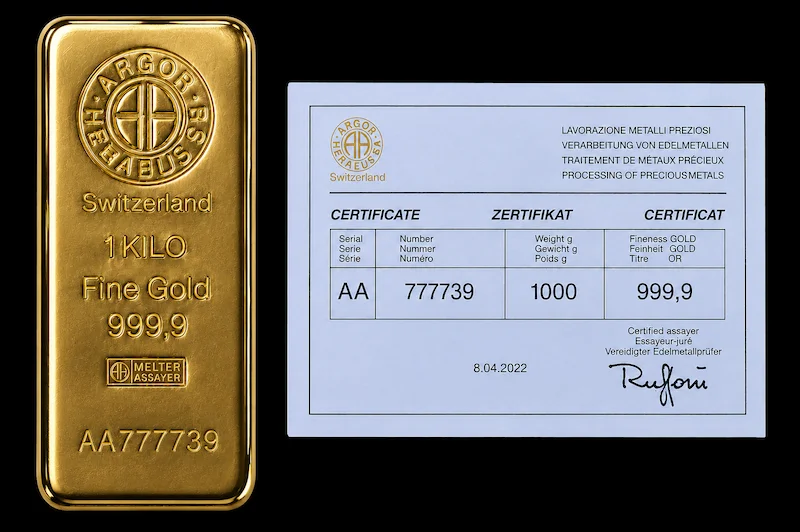
Below the Good Delivery format, AH casts in a graded range: 5,000 g, 3,000 g, 1,000 g, 500 g, 250 g, 100 g, 50 g, and the 10 tola format (3.75 troy oz, oriented to South Asian wholesale flows). Each carries the AH stamp at cast and ships with a numbered assay certificate matched to the bar’s serial. The 1 kg cast bar is the institutional sub–Good-Delivery default — 999.9 fineness, AH stamped and certified, kilobar granularity inside refinery-origin supply that reconciles cleanly into AH’s 400 oz production-record chain. Above kilobar scale, the 5,000 g and 3,000 g formats serve buyers whose value blocks sit between kilobar and Good Delivery, where pure-kilobar holdings at high tonnage would otherwise multiply bar count past what’s manageable for vault accounting. The 250 g, 100 g, and 50 g cast bars run against retail-adjacent and watch-industry distribution outside the institutional perimeter.
Minted bars
Parallel to cast, AH operates a minted line covering 1/4 oz, 1/2 oz, 1 oz, and 1 g through 100 g. Production runs at the press: refined blanks rolled and blanked to size, struck under die pairs that apply the AH design and the bar’s marks in a single operation. Fineness convention is 999.9; bars ship in numbered tamper-evident assay cards. Per-bar premium sits above cast from the same refinery — press economics differ from pour economics — and the format’s primary use cases run outside wholesale acquisition, in gift and presentation, retail-adjacent distribution, and jewellery-industry input.
Beyond AH’s own brand, the press also produces under partner-bank marks. UBS, Raiffeisen, the Austrian Mint, and others contract Argor-Heraeus for minted output, with the bar visible to the holder carrying the partner stamp over refiner’s-quality production. The Kinebar® sits inside the minted line as its own sub-format — the AH minted product where press economics meet a counterfeit-deterrence layer the cast formats do not carry.
The Kinebar®
Globally, Argor-Heraeus is the only refinery that produces Kinebars. The format launched in 1994 in 1 g, 2 g, 5 g, 10 g, 20 g, and 1 oz weights, with the 50 g and 100 g Kinebars added in 2012. Every Kinebar carries .9999 fineness, an AH stamp on the obverse with serial, the Kinegram® on the reverse, and a sealed numbered tamper-evident assay card.
Behind the Kinegram sits OVD Kinegram AG. The Swiss specialist designs and produces the diffractive optically variable image device under licence to Argor-Heraeus, with the same core technology that underwrites passports, banknotes, and government-document authentication globally — civilian-grade Kinegrams do not exist outside this licence network. Pressed into the gold surface at less than 0.0015 mm depth, the engraving sets a reproduction floor that surface-printed substitutes and inferior holograms cannot meet.
Reading the bar is direct. Tilt shifts the diffractive pattern through a colour-and-motion sequence specific to the impression, and the response is unmistakable to vault staff who have handled an authentic bar. Where Argor-Heraeus production runs under partner brands — Kinebars distributed under UBS, Raiffeisen, and Austrian Mint marks are AH refinery output under licence — the Kinegram travels with the bar regardless of the partner stamp on the obverse.
Verification: reading an Argor-Heraeus bar
Verification reads through the bar in layers. Each layer answers a separate question; together, they let a counterparty admit the bar at sight, without external assay, into the wholesale acceptance protocol that the AH stamp credentials. A buyer or vault receiving an Argor-Heraeus bar walks the sequence in order. Any layer that fails sends the bar into re-verification — re-weighing, re-assay, production-record reconciliation against the refinery — before it re-enters the network at full status.
The AH hallmark and stamp anatomy
Across AH production, the face of every bar carries a fixed mark structure. The brand hallmark reads as “Argor-Heraeus SA” inscribed in a circle around the AH monogram, with “Switzerland” below; alongside, “AH Melter Assayer” appears in a rectangular cartouche, identifying Argor-Heraeus in the technical role the LBMA Good Delivery Rules require named on the bar. The fineness stamp records the bar’s actual purity — 995.0 or higher on cast Good Delivery; 999.9 conventional on cast bars below Good Delivery and on minted formats. From 1988 onward, the year of manufacture is stamped alongside.
An institutional buyer reads that stamp set against the LBMA Active List version in force on the bar’s year of manufacture. A bar cast in 1995 maps to the 1995 list; a bar cast in 2018 maps to the 2018 list. Argor-Heraeus has held continuous Active status across the period, so every year of AH production resolves to an affirmative read. The match is fundamentally temporal: bar year selects the List version, and the List version returns the refiner’s standing at that year.
Serial number system and numbered assay cards
From cast or strike onward, every AH bar carries a unique serial number. On 400 oz output the numbering scheme has run unchanged since 1952 — six decades of production records against one continuous system. Each serial ties the bar to its casting lot in the refinery archive, and the archive ties the lot to assay records, weight records, and the supply-chain documentation that ran against the gold input.
Below 400 oz, the serial appears twice: stamped on the bar itself and printed on a numbered assay card sealed in tamper-evident packaging. The card carries the AH chief assayer’s signature, the bar’s weight, fineness, and serial. Verification is a cross-read against the bar — serial-to-serial, declared weight against stamped weight, declared fineness against stamped fineness, and seal intact.
Any single mismatch sends the bar into re-verification. The serial on the bar fails to match the card. The weight stamped on the bar diverges from the weight on the certificate. The fineness mark and the certificate disagree. The seal is broken. Each is a separate trigger, and each pulls the bar out of onward custody until the discrepancy reconciles against the refinery’s production record or, where reconciliation fails, against re-assay.
Kinegram optical security on minted Kinebars
On every Kinebar’s reverse, the Kinegram adds an authentication layer that runs without documentation, archives, or external query. Incident light is enough: tilting the bar shifts the diffractive pattern through a colour-and-motion sequence specific to the impression. Reproduction at authentic depth and resolution would require the engraving and stamping infrastructure that produced it; surface-printed substitutes, foil overlays, and inferior holograms fail under tilt inspection within seconds.
Vault staff or a receiving buyer use the Kinegram as first-pass authentication. The check is direct: tilt, observe the response, compare against the known pattern from authentic AH production. It runs in real time at handover. Where the response doesn’t match — pattern flat, colour absent, motion sluggish — the bar comes off the conveyor at the physical layer, before the paperwork is opened.
Tamper-evident packaging and the documentary chain
At the bar layer, packaging carries the first defence against tampering. Minted AH bars and Kinebars ship in sealed assay cards designed to break visibly under any attempt at extraction. Cast bars below 400 oz ship with their numbered certificate and protective packaging keyed to the bar’s serial. Both classes act as evidence at the receiving end. An intact tamper indicator confirms the bar has not been separated from the documentation it was sealed with. A broken seal — regardless of the condition of the bar inside — sends the bar into re-weighing and re-verification before it continues.
Above the bar layer, the documentary chain runs refinery → carrier → vault. AH’s production records key the bar’s serial to the casting lot, the lot’s assay, and the supply-chain due diligence behind the gold input. The accredited carrier’s chain-of-custody record keys the same serial to handover events between refinery, transit, and vault. The vault’s allocation record keys it to the buyer’s account.
Vault entry is where the chain reconciles. The bar arrives. The seal is checked. The marks are read. The serial is cross-referenced against the carrier’s manifest, against the production record on file, then entered against the buyer’s allocation. Each link resolving to the same identifier puts the bar into allocated stock. Any link unresolved holds the bar at vault intake until reconciliation completes.
Where Argor-Heraeus gold bars fit in Golden Ark Reserve’s supply
At the sourcing stage, Argor-Heraeus SA bars enter Golden Ark Reserve’s supply through the Heraeus official supplier framework — the contractual path under which Heraeus Precious Metals, the parent business unit since 2017, makes refinery-origin AH bars available to GAR’s institutional offering. Bars leave Mendrisio with the AH stamp at cast, the serial entered into the refinery’s production records, and — on every format below 400 oz — sealed into the numbered assay card that travels with the bar from then on.
After refinery release, the bar moves to allocated vault placement in the buyer’s name. Carriage and vault execution run through Brink’s. Sealed handovers at each transition. Serial reconciles at every step against the documentation in transit. Golden Ark Reserve does not hold client gold; the bar lives at the third-party vault under the buyer’s allocated account, and Brink’s executes storage and movement against contract.
For transaction documentation, the evidence set is keyed to the bar. The package centres on the purchase agreement, which specifies refiner, serial, gross weight, and fineness. Around it sit the AH numbered assay certificate (or the 400 oz weight list), the AML and KYC record, the payment confirmation, and the allocation record entered against the buyer’s account. Every document references the bar by the same serial.
End to end, the bar layer reconciles. Mendrisio casting to vault allocation, with refiner identity, accreditation, and verification preserved through every handover. Available AH formats and supply terms are listed on the LBMA Good Delivery gold bars page. For institutional acquisition, the contract path runs through Golden Ark Reserve’s purchase channel.