

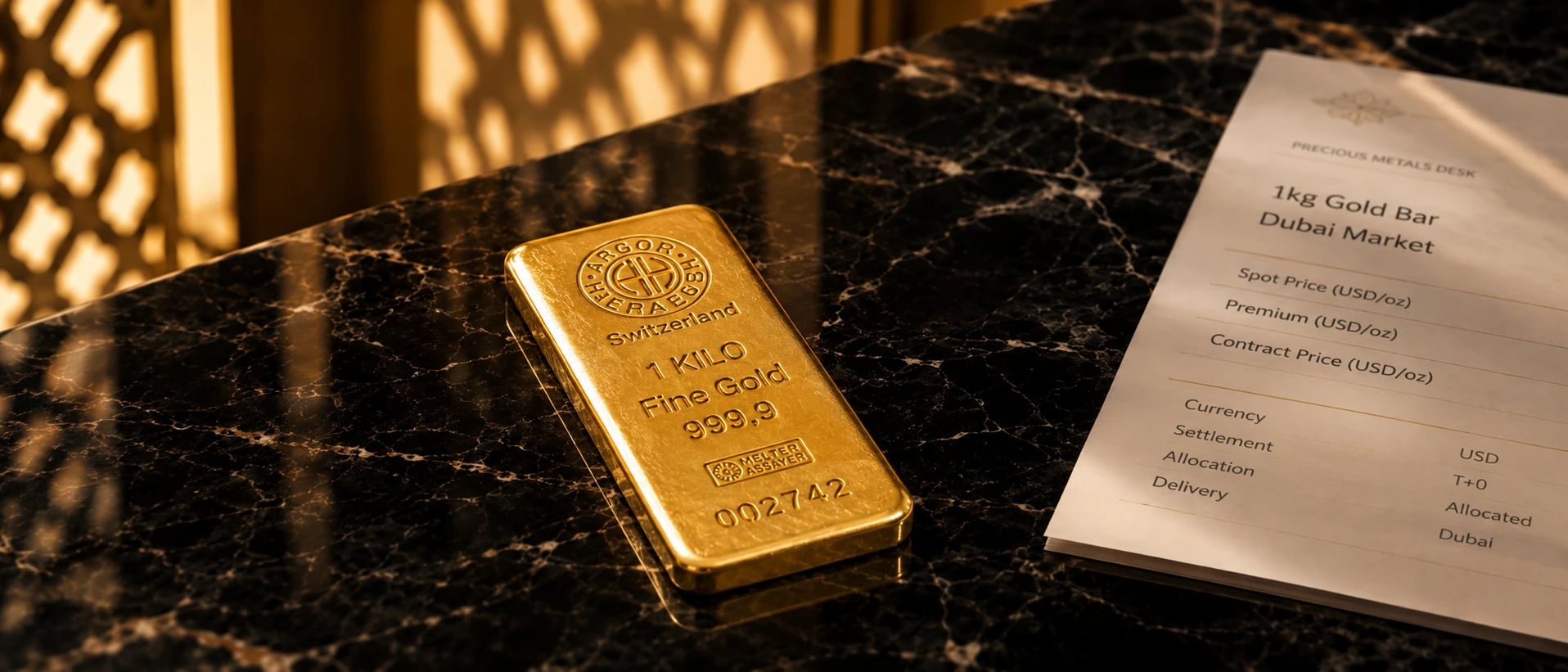
Two prices sit behind any quote on a 1 kg gold bar in Dubai. One is the spot reference per kilogram — a market input anyone can read. The other is a premium, set by the refiner, the bar format, the settlement route, and the counterparty handling the trade. A public rate tracker shows the spot leg and stops there, so its headline figure runs below what an institutional purchase settles at. For a family office, corporate treasury, or procurement desk pricing a kilobar against the Dubai market, that gap raises the working questions — what fixes the per-kilo reference, what the premium pays for, and how the bar moves from a cross-border contract into allocated custody and onward delivery, with the trading counterparty outside the UAE.
How a 1 kg gold bar is priced: spot, premium, and per-kilo reference
Spot and premium move on different clocks. The reference price resets continuously across the trading day; the premium stays fixed against a given bar and route until the refiner, the format, or the delivery terms change. Together they make the transaction price — spot alone only prices the metal.
The spot reference and the troy-ounce-to-kilo conversion
Quoted per troy ounce in the over-the-counter market and settled loco London, gold spot carries a twice-daily benchmark — the LBMA Gold Price — alongside a parallel futures reference on COMEX. One kilogram holds 32.1507 troy ounces, so the per-kilo reference is the per-ounce price scaled by that fixed factor; dealers and trackers publish in either unit, and mistaking an ounce figure for a kilo figure brings the line in roughly 32 times short. Bid, ask, and mid all sit in the same quote, which revises through the session, so a price holds only for the moment it is struck — a per-kilo figure recorded yesterday describes yesterday’s market. Against that moving reference, the live per-kilo gold price reference is tracked on its own page; for budgeting, the number that counts is the one confirmed when the quote issues.
What the premium covers
Above the metal price sits the premium, the layer a public tracker stops short of — it prices the metal, while the finished bar in custody costs more. Premium size answers to the refiner above all; a bar from a recognized LBMA Good Delivery refiner prices apart from generic stock. Format moves it again, a minted bar carrying a higher fabrication premium than a cast bar of equal weight. The route supplies the rest. Allocated custody and the carriage and insurance of moving the bar carry cost, and the counterparty’s margin sits on top — all inside the all-in figure. Strike two quotes against one spot reference and they can still land far apart — the premium is where they diverge.
Either way, the all-in quote is the figure a budget answers to; the spot reference is only its starting point.
Why a Dubai retail listing and an institutional quote are different numbers
Search the Dubai market and two numbers come back, each attached to a different kind of sale. On a retail dealer’s board or a public per-kilo tracker, the first prices a local, over-the-counter purchase; sourcing a 1 kg refinery-origin bar through an institutional counterparty produces the second. Each number reads true for the sale it describes, and weak as a proxy for the other.
| Dimension | Local retail / public tracker | Institutional 1 kg purchase |
|---|---|---|
| Unit priced | a smaller retail denomination | a single one-kilogram bar |
| Delivery | immediate physical handover | documented cross-border settlement |
| Settlement | the local market | the contracting entity, outside the UAE |
Three attributes mark the institutional purchase — refinery-origin sourcing under LBMA Good Delivery, allocated custody in the buyer’s name, and eligibility cleared by AML/KYC and sanctions screening before a quote issues. For a procurement approval, the baseline has to match the purchase in front of the desk. Bring the institutional quote and it holds against what settles; bring the tracker figure and the approval rests on a sale that belongs to a different market.
Purchasing through the Sohar Free Zone: contracting, gating, and records
Under this route, the contract for a 1 kg purchase sits in the Sohar Free Zone, in the Sultanate of Oman. A Dubai-based buyer reaches that entity cross-border, and the location of the contract carries through to which rules govern the deal and what the buyer ends up holding. The metal is refinery-origin bullion from Heraeus and Argor-Heraeus; custody and onward delivery run through Brink’s. Two things set this route apart from a local counter purchase — the eligibility gate that runs before pricing, and the record the deal leaves behind.
Counterparty eligibility and AML/KYC gating
Before pricing, the counterparty runs its screen. It verifies identity and beneficial ownership and reviews source of funds. Sanctions screening runs against the major lists — OFAC, EU, UK, and UN among them. That same screen carries supplier-side restrictions down from the refiner agreements and LBMA Good Delivery supply-chain standards, so eligibility turns on those terms as much as on the buyer’s own profile, whatever the size of the order. Clear the gate and a quote follows, opening a documented relationship from the first priced exchange. The screen is the condition the sale runs on, and for a qualified institutional buyer it cuts both ways — the check that admits one counterparty is the check that keeps the rest qualified. Detailed controls sit in AML and KYC requirements.
The documented transaction record
Settlement produces a documented record, assembled from a defined set of parts into the Evidence Set the buyer receives:
- the contract;
- the AML/KYC file;
- payment confirmation;
- an Allocation Record identifying the specific bar by serial number;
- vault-placement or delivery documentation, depending on the instruction.
For a corporate treasury or family office, that set is what carries the holding onto the balance sheet and through audit — ownership of an identified, serial-numbered bar in allocated custody, backed by document at each step. Where a handover ends with bullion in hand, this route ends with a holding that audit can trace.
Through the Sohar Free Zone route, a Dubai-based buyer ends with a cross-border contract and a fully documented holding, the eligibility gate already behind it.
Bar specification and refinery origin: Heraeus, Argor-Heraeus, and LBMA Good Delivery
Before it carries a price, the bar is a defined object, and that specification is what an audit later checks against.
| Attribute | 1 kg institutional bar |
|---|---|
| Weight | one kilogram |
| Fineness | 999.9 fine gold — four-nine purity |
| Cast bar | poured into a mould |
| Minted bar | struck from a rolled blank; carries the higher fabrication premium |
Choosing between cast and minted trades cost against presentation — the minted bar’s premium against the cast bar’s lower cost — while the metal content stays identical. Dimensional detail for the kilogram bar sits on the 1 kg gold bar page.
Origin is what turns a described bar into a verifiable one. The metal comes refinery-origin from Heraeus and Argor-Heraeus, both accredited on the LBMA Good Delivery List — the standard that lets a refiner’s bars clear the wholesale market without re-assay. Proof sits on the metal itself. Each accredited bar carries the refiner’s stamp and a stated fineness, plus a unique serial number and an assay mark. Recorded in the Allocation Record, that serial number pins the document to one identified bar. Checked against the LBMA standard and its own stamps, a holding stands on an external reference, and the serial on the bar is the serial an auditor reads off the record.
Allocated storage and onward delivery through Brink’s
After settlement, the allocated bar is placed under Brink’s vaulting arrangement. The specific serial-numbered bars are held in the buyer’s name and segregated from other stock, recorded against the buyer on the vault’s books. That allocation is reflected in the vaulting and allocation cost — an allocated bar stays the buyer’s property if the custodian fails, while an unallocated balance ranks as one claim among the custodian’s creditors. The serial number in the Allocation Record matches the bar on the shelf, and allocated storage and custody covers the vaulting arrangement in full.
From the vault, the holding follows the buyer’s instruction. It can stay in allocated storage, or move under a release instruction and carrier authorization into cross-border delivery, with Brink’s carrying allocated bullion to more than a hundred countries and the movement logged into the transaction record. A Dubai-based buyer holds the bar in a vault jurisdiction or takes delivery to a named destination; either way, the instruction sets the location and the record captures the move.
Starting a 1 kg purchase from Dubai
Before a firm number exists, the buyer asks for a quote. Struck against the live spot reference the moment it issues, the quote holds firm only after the bar’s refiner and format are chosen and its delivery route is set, at which point the premium is fixed and the figure stands for that moment alone. Eligibility clears first. Only then does the number open inside a documented relationship for a qualified counterparty.
From Dubai, the sequence runs cross-border into the Sohar Free Zone entity:
- Request a quote, which returns once identity, source of funds, and sanctions screening clear.
- Specify the bar format — cast or minted.
- Set the holding to stay in allocated storage or move to delivery.
- Receive the Evidence Set against the settled bar.
Onboarding through settlement, the physical gold purchase process carries the same route for qualified counterparties.