

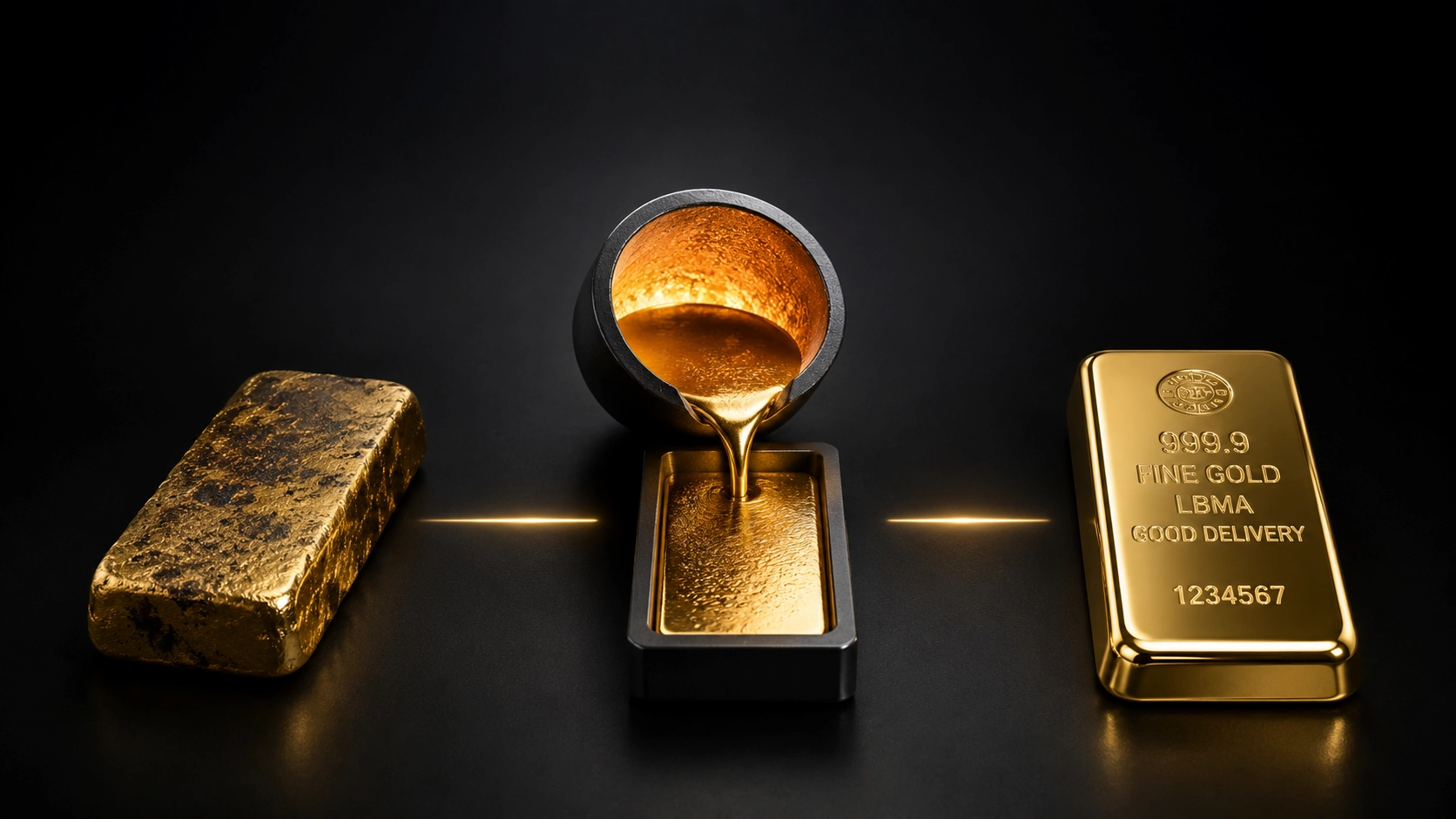
Mined gold reaches the refinery as doré, a semi-refined casting that has to be processed before any market will settle it as bullion. Doré runs typically 60–90% fine, the balance mostly silver with base metals such as copper, iron, and lead. London Good Delivery begins at 995 parts per thousand fine gold, and market preference commonly sits at 999.9, so the metal passes through an accredited refiner to reach a tradeable fineness. Refining gives a buyer a verified fineness to rely on. It also generates the assay record that proves that fineness and applies the bar marks that carry the bar’s identity through every later transfer. The chemistry behind this has held for decades, from chlorination at roughly 995 to electrolysis at 999.9 and above. The reporting around it has changed faster. A Good Delivery refiner today declares the country of origin of its metal once a year, and from 2027 it will report this monthly through the LBMA’s Gold Bar Integrity database. What follows traces the gold refining process accredited refiners run today, from doré intake to the standard that admits a bar as investment-grade.
What gold doré is — and why it can’t trade as investment bullion
At or near the mine, gold concentrate is cast into doré — the standard form for moving mined gold to a refinery. Its gold content tracks the orebody and commonly sits around 80%, silver making up most of the balance, with base metals such as iron, copper, nickel, lead, and tellurium present in smaller amounts. That composition is what keeps doré below investment fineness. London Good Delivery starts at 995.0 parts per thousand fine gold and every recognised investment standard begins at or above that level, well clear of where doré arrives.
Allocated bullion has entry conditions doré meets only after refining. A vault books metal as allocated bullion, and a Good Delivery counterparty settles it, once it carries a refiner’s fineness and marks at or above the standard. Doré reaches that state by passing through an accredited refiner, which returns fine gold; only that output trades and stores as bullion. Acquiring doré as feedstock is a separate commercial activity from the refining described here — see gold doré purchase.
From doré to fine gold: the refining process
Inside an accredited refinery, doré moves through a fixed sequence — intake, melt and assay, primary refining, optional high-purity refining, then casting and marking — and each stage fixes a parameter the next one depends on.
Intake and sourcing due diligence
Before any metal reaches the furnace, the refiner records at intake what the material is — mine doré, investment-grade scrap, or Good Delivery bars returned for re-casting — and runs country-of-origin and responsible-sourcing checks against the OECD due diligence framework and the LBMA Responsible Gold Guidance, the document underpinning the Responsible Sourcing Programme, currently version 9 (finalised November 2021). Material that fails these checks does not enter the Good Delivery system, whatever its gold content.
From 1 January 2026, disclosure at this step has widened. Under Disclosure Guidance Version 3, a refiner publicly discloses the identity of the refiner and the local exporter in OECD red-flag locations, all World Gold Council mines from which it receives material, and all countries from which mined material is received. Country-of-origin data, reported once a calendar year today, becomes a mandatory monthly submission through the LBMA Gold Bar Integrity database from 2027. For a counterparty downstream, the sourcing record behind a bar stops being a private assurance between refiner and association and becomes structured data the market can hold the refiner to.
Melt, homogenise, and assay
In the melt house, the doré goes into an induction furnace and is stirred until the melt is uniform. Fluxes — borax and soda ash — combine with oxides and base metals to form a silicate slag that is skimmed from the surface. Homogenising governs what follows: the assay is only as accurate as the melt is uniform.
From the homogenised melt the refiner takes representative dip samples and assays them. The assay fixes the exact gold, silver, and impurity content, sets the valuation of the lot, and determines the refining route — whether primary refining alone will reach a castable Good Delivery fineness, or whether the metal must also go to electrolysis for 999.9. Fire assay by cupellation is the definitive method; XRF gives a rapid, non-destructive reading for screening. An unrepresentative sample misstates both the price and the route.
Primary refining (Miller) to 995
First comes the Miller process. The refiner blows chlorine gas through the molten gold, where base metals and silver react to form chlorides while the gold stays in the melt; those chlorides leave as vapour or as a low-density slag that is skimmed off. Output runs at 995 to 996 fine, which casts directly into a London Good Delivery bar and goes to market in that form. This is the operationally significant point. 995 is the Good Delivery minimum, so Miller reaches wholesale tradeable metal in a single step, and a large share of wholesale gold stops here. By one Degussa estimate, around two-thirds of all the gold ever refined has passed through the Miller process.
Two conditions route metal past Miller to a second stage. Gold that must meet 999.9 needs electrolysis, and feed carrying platinum-group metal needs a process that separates it, since platinum chloride behaves much like gold chloride under chlorination and stays with the gold. Where the feed carries neither, the Miller bar is the finished wholesale product.
High-purity refining to 999.9
Reaching 999.9 requires a second stage. The standard route is the Wohlwill process: the refiner dissolves the Miller-refined gold into a gold-chloride and hydrochloric-acid electrolyte and redeposits pure gold on a cathode by electrolysis, reaching up to 99.999% fine. Wohlwill is used where exacting purity is required, but it is slower and ties up a large gold inventory in the form of chloroauric acid in the electrolyte, which is why refiners run it only for metal that has to meet the higher fineness. Most accredited refiners produce 999.9 as their standard bar, and the Swiss refiners that dominate kilobar and small-bar supply run it at scale.
Two other routes exist. Aqua regia — dissolution in hydrochloric and nitric acid, precipitation of gold powder, re-melt — serves smaller batches and refiners without electrolytic lines. Hydrometallurgical solvent extraction, including the Minataur process, takes a high-gold feed through an oxidative leach, a continuous solvent-extraction circuit that holds only a small gold inventory, and precipitation to 99.99% and above; refiners in South Africa and Dubai use it. Advances in ion-exchange resins and novel solvents have improved selectivity and sustainability over historical methods, though this remains a route for specific feeds rather than a replacement for Wohlwill.
Casting, marking, and the bar record
Once refining is complete, the refiner casts the gold into its delivery format — a 400 oz Good Delivery bar, a 1 kg bar, or 1 oz blanks and granules — and verifies the final fineness before the bar leaves. Good Delivery bars are cast only; kilobars, 100-ounce and smaller bars are not acceptable in the London wholesale market, though they may be in other markets or exchanges.
At the final step, marks turn a cast bar into a tradeable one. A Good Delivery bar carries the refiner’s stamp, the fineness to four significant figures, a serial number, and — for bars produced from January 2019 onwards — the year and month of manufacture; a bar missing any of these falls outside Good Delivery regardless of its metal. The January 2026 edition of the Good Delivery Rules tightened that specification. From 1 January 2026, non-Roman lettering, including Cyrillic, is prohibited in serial numbers, the month-year code, and fineness markings, and fineness, date, and serial characters must stand at least 12 mm high and at least 10 mm from the edge. The Cyrillic prohibition operates as a sourcing control as much as a typographic one. The complete bar record this produces — its assay and sourcing deliverables alongside the stamped marks — is what the refiner now files into the LBMA Gold Bar Integrity database. With that record in place, the bar changes hands on its marks, without re-proving its metal at each step.
Refining methods compared
Feed and target fineness set the method. The feed’s gold content and the fineness the bar must reach together govern turnaround, cost, and whether the metal can reach 999.9.
| Method | Typical fineness | Scale / mode | Applied to | Principal limit |
|---|---|---|---|---|
| Miller (chlorination) | 995–996 | High-throughput, low cost | Bulk primary refining; output castable as a 400 oz Good Delivery bar | Cannot separate platinum; cannot efficiently reach high purity |
| Wohlwill (electrolysis) | 99.99–99.999% | Slower, capital-intensive, continuous baths | Metal that must meet 999.9 or carries platinum-group content; usually run after Miller | Ties up a gold inventory as chloroauric acid in the electrolyte |
| Aqua regia (chemical) | ~99.99% | Batch, smaller scale | Smaller lots and scrap; refiners without electrolytic lines | Acid handling; batch throughput |
| Solvent extraction / ion exchange (e.g. Minataur) | 99.99% and above | Continuous, with only a small gold inventory held in circuit | High-gold feeds; used by refiners in South Africa and Dubai | Aqueous and organic waste; reagent cost |
Most feeds need more than one method. An accredited refinery runs Miller and Wohlwill in sequence and keeps chemical routes for specific batches. Advances in ion-exchange resins and tailored solvents have improved selectivity and sustainability over older methods, and solvent extraction now serves particular high-gold feeds where electrolysis once stood alone. One method on the list sits apart. Cupellation is an assay method, covered under quality control below, not a production route.
What makes bullion “investment-grade”: LBMA Good Delivery and the 995-vs-999.9 line
Investment-grade status follows from the full London Good Delivery specification, met by an accredited refiner; fineness on its own is only one component of it. For delivery in the London bullion market, a bar has to come from an LBMA-accredited refiner, and those refiners face periodic re-audit that keeps accreditation current. A bar built to the full specification by a refiner on the Good Delivery List clears dealers worldwide on inspection of its marks, and it needs no re-assay to do so. That worldwide acceptance is the commercial substance of the term. A holder can settle and store the bar internationally on the strength of the refiner’s accreditation and the bar’s marks alone.
The 995.0 minimum is the floor; refiners generally aim higher. A Miller-refined 400 oz bar at 995–996 already qualifies and trades in the London wholesale market in that form. Investment buyers work to 999.9 as their default, and most accredited refiners cast to 999.9, well above the floor. The two levels do different jobs. The 995 floor governs wholesale acceptance of large cast bars, while 999.9 governs investment preference and is standard for kilobars, small bars, and markets that price to four-nines; East Asian demand in particular drove the growth of the 999.9 market. A holder selecting a format is selecting the fineness its destination market expects, inside a single standard that runs from 995 upward.
Beyond fineness, the specification fixes the bar’s form. A Good Delivery bar holds roughly 400 troy ounces within an accepted 350 to 430 fine-ounce range, about 12.4 kg, and it must be cast; kilobars, 100-ounce and smaller bars trade in other markets and exchanges, outside the London wholesale standard. The full specification runs to five elements — fineness, form, weight, marks, and the sourcing record — and a bar short on any one of them sits outside Good Delivery whatever its gold content. Those mechanics are set out in full on a dedicated page, LBMA Good Delivery gold bars explained.
How fineness is verified: assay and quality control
A counterparty rarely handles the bar whose fineness it trades on, so the stamped figure has to stand on the assay method behind it and on the LBMA’s monitoring of who performs the assay. For gold the reference method is fire assay, also called cupellation or gravimetric assaying: the sample is melted with lead and fluxes to drive off impurities, and the remaining gold is weighed. It holds that reference position because it delivers the accuracy that the production, purchase, and toll treatment of doré demand. Corrected fire assay carries most of the Good Delivery range; around 999.5 and above, spectrographic methods reach the precision required. Every gold refiner on the List has to assay accurately across the full 995 to 999.9 range.
Every three years, under Proactive Monitoring, the LBMA reviews a refiner’s assaying competence against a supervised dip sample taken from a normal melt. Two samples go to LBMA referees for check-assay, the rest stay on site, and the refiner’s own analysis of one sample is compared against the referees’ to settle a pass or fail. The dip sample is fixed at 10 g for gold. Its purity sits in a 995 to 999 window. A disagreement beyond tolerance sends the refiner back to a spare sample, which is re-assayed and reported again; a clear failure can call for further samples or, at the limit, re-application for Good Delivery status.
Seven referees anchor this system, each a refiner working to a standard above what the List itself requires. A new applicant submits unmarked large bars, examined in a London vault and split into two batches for two referees, with the applicant’s name withheld throughout. The same system fixes how a borderline number is expressed. Assays run to five significant figures and round to four, and at 995, 999.9 and 1,000 the figure rounds down, so an assay of 994.99 records as 994.9 and stays below 995.0. A bar holds its fineness threshold on the metal, never on rounding. That recurring, independent cross-check is what stands behind the number stamped on the bar. It lets allocated metal change hands and settle internationally without re-assay at each step.
Provenance and the digitalising chain of custody
Assay settles what a bar is. Provenance settles where its metal came from, and this is the part of the refining chain that has moved most since 2024. Country-of-origin data and sourcing assurance are leaving annual paper records for a shared digital platform, on a reporting schedule that becomes mandatory, with scientific origin checks emerging at the leading edge.
Bar-level traceability and mandatory country-of-origin
Live since January 2025, the LBMA Gold Bar Integrity database runs on aXedras distributed-ledger technology and now centralises this reporting. By the start of 2026 every Good Delivery refiner was using it to upload data and assurance deliverables, replacing the email process that came before. The Good Delivery gold list runs to 66 refiners.
Today a refiner files its country-of-origin data once a calendar year, and the database is set to tighten that cadence. From April 2026 it can file the same data through the platform voluntarily, on a cumulative basis, and from 2027 monthly reporting becomes mandatory for every Good Delivery refiner. Custodians follow the refiners onto the platform. By December 2026 they are to be onboarded and reporting aggregated vault holdings, with bar-level reporting stated as the next step. For a downstream counterparty this resets the status of a bar’s sourcing record. What was a private, annual assurance between a refiner and the association becomes structured data on a shared platform, updated far more often and open to reliance by a buyer or its compliance function rather than taken on trust.
Scientific origin and bar authentication
Beyond the database, two technologies answer questions documentation leaves open. The first is whether a given bar is genuine. Optical-AI systems such as Alitheon’s FeaturePrint take a photograph of a bar — minted or large cast — and generate a digital fingerprint that identifies, authenticates, and traces that individual bar, a capability the LBMA recognises within its accredited bar security features.
Origin is the second question, and answering it takes chemistry. In November 2025 aXedras introduced xTrace, an AI-powered origin-verification technology. It reads a sample on connected XRF or ICP instruments, builds a chemical fingerprint, and uses AI to test whether mined material matches its declared source, from rock face to refinery. Early adopters include Argor-Heraeus, whose co-chief executive presented on the technology at the 2026 Bullion Integrity Forum alongside Rand Refinery and others. ABC Refinery runs a parallel deployment. It applied Source Certain’s forensic trace-element science to confirm origin and made the result accessible through an app that lets a buyer scan a numbered kilobar for its mine origin and certification data. Both run ahead of any requirement, though analysts at Metals Focus have suggested trace-element verification could become an LBMA requirement within three to five years. Together the two methods give a counterparty what the marks and the assay certificate leave out, namely independent confirmation that a specific bar is authentic and that its metal came from where the record states.
Responsible sourcing and the recycled-feedstock question
Beneath the technology sits the rule the metal must satisfy to enter the system at all. The LBMA Responsible Gold Guidance, currently version 9, underpins the Responsible Sourcing Programme; it follows the OECD five-step due diligence framework, requires refiners to address money laundering, terrorist financing, human-rights abuses, and environmental harm, and is verified by annual assurance, with all metal from Good Delivery refiners subject to that process. Only metal that meets it enters the chain.
The material arriving for that assurance is shifting. Recycled gold has risen as a share of supply, from 23.8% in 2022 to 27.6% in 2024, reaching a twelve-year high of 28.7% in the first half of 2025. The price response stayed restrained: full-year 2025 recycling rose only 3%, to 1,404 tonnes, against a 67% increase in the gold price. Recycled material is now a growing portion of refinery feed, and it carries its own sourcing risk under the same OECD-aligned checks that apply to mined doré. The wider that feed runs, the more incoming material a refiner has to screen before it qualifies. Golden Ark Reserve sets out its own compliance and sourcing posture at compliance & legal.
Who owns the metal: toll refining, outturn, and the refiner’s role
Under the toll model that governs most refining, the supplier of ore, concentrate, or doré keeps title to the metal throughout and pays the refiner a fee to process it. The refiner raises the metal’s purity and returns it; ownership stays with the mining company or other supplier from start to finish. Refining is therefore a paid service performed on someone else’s metal.
On completion, the refiner returns an outturn to the supplier. A supplier can sell its mine outturn outright to the refiner or toll it through the refinery; under tolling, the refiner processes the shipment for a fee and returns an agreed share of the metal in the doré in a set form, such as a kilobar or 100-ounce bar, at a set time and place. Most of this runs on contract, often covering a year of batches. Settlement ties back to the assay. Where the mine’s and the refiner’s assays sit within a defined splitting limit, the two figures are averaged, so the fineness proven at sampling is also the figure that settles the toll.
A bullion bank commonly takes ownership once the bar is refined. Up to that point the gold generally belongs to the mining company; the bank then performs a clearing role, buying when producers want to sell. The refining floor produces and certifies the bar, while financing, ownership, and onward sale sit with other parties.
A trading counterparty operates in exactly this split between producing the bar and owning it, the same chain this page has traced from the production side. Golden Ark Reserve acts in that chain as a licensed trading counterparty and execution coordinator. The refinery-origin bars come from the named anchors, Heraeus and Argor-Heraeus SA; custody and vaulting, where engaged, run through Brink’s; and the transaction and the allocated holding are recorded in documentation. Its own work is to source the metal and coordinate the parties through to that documented, allocated holding.
Investment-grade status is set at the refinery and travels with the bar — in its fineness, its marks, its assay record, and now its digital provenance — while ownership and trade belong downstream of the refiner. A holder who wants physical metal enters at that downstream layer. They take refinery-origin bars into an allocated holding, with the documentation that evidences both, through a trading counterparty. That route begins at buy physical gold.