

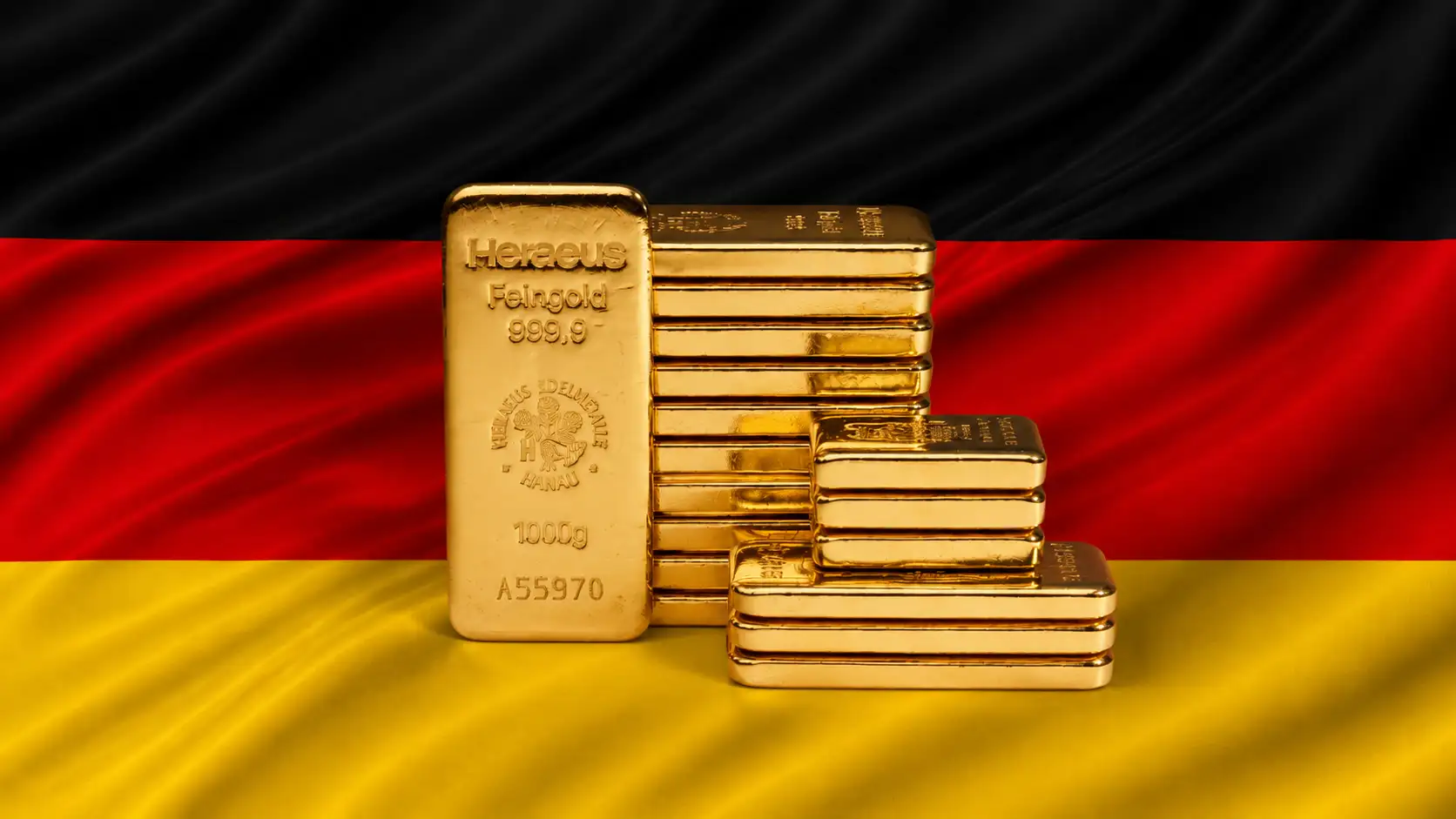
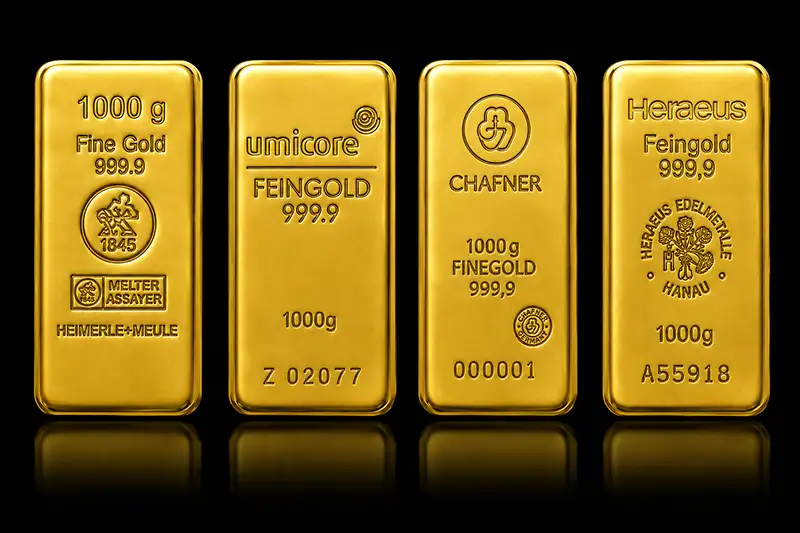
A German gold bar is one refined in Germany by Heraeus, Heimerle & Meule, C. Hafner, or Agosi — four LBMA Good Delivery accredited refiners, one based in Hanau and three clustered in Pforzheim. Between them they cover Germany’s share of the international wholesale bullion market under LBMA standards and the German federal precious-metals framework. The refiner behind a given bar determines its mark, its available formats, and how readily it resells. Each carries its own ownership, refining heritage, and format focus — the differences that shape the choice between them.
What “German-refined gold” denotes
Refining and bar-forming on German soil — by Heraeus, Heimerle & Meule, C. Hafner, or Agosi — is what the “German” marker certifies on a gold bar. The metal itself can come from anywhere: mining doré sourced internationally, recycled gold and end-of-life industrial precious metals, or wholesale gold acquired from other refiners. Germany has no commercial gold mining domestically, so the origin marker describes the location of the refining and casting or minting step. German depth runs particularly in the recycling stream — each of the four refiners operates recycling and recovery lines around its bullion business, processing electronic-industry scrap, jewelry-trade returns, and industrial residues alongside mine-origin metal. Accreditation under the LBMA Good Delivery standard, performed inside Germany’s federal precious-metals framework, is the substance behind the marker.
Two regulatory layers apply at once — one international, one national. LBMA Good Delivery, administered by the London Bullion Market Association, accredits refiners on assay accuracy, financial standing, and supply-chain due diligence; bars produced to the Good Delivery specification by an accredited refiner are deliverable into the wholesale market. The German federal layer rests on several statutes. Fineness marks and hallmarking come under the Feingehaltsgesetz (Law on the Fineness of Gold and Silver Wares, 1884). The Bundeszollverwaltung administers customs and trade rules covering bullion movement across German and EU borders. The EU investment-gold regime — Council Directive 98/80/EC, transposed nationally as §25c of the Umsatzsteuergesetz — grants VAT-exempt status to investment gold meeting the directive’s specifications. Each regime does different work: LBMA accredits the refiner internationally and certifies the bar’s deliverability, while the German federal layer governs the operational and fiscal treatment of bullion inside Germany.
In contract terms, German origin opens onto refining at scale. Heraeus runs one of the largest precious-metals operations in the world, and the four together account for a substantial share of LBMA Good Delivery gold each year — with refiner marks (Heraeus’s most of all) carrying weight in the international secondary market. Format coverage across the four spans 400 oz cast bars, cast and minted kilobars, sub-kilo branded products, and semi-finished and grain output, all inside one regulatory perimeter.
The four LBMA-accredited German gold refiners
Three of the four — Heimerle & Meule, C. Hafner, Agosi — operate in Pforzheim, the Baden-Württemberg precious-metals town that has run as a refining and jewelry centre since the late eighteenth century. The fourth, Heraeus, sits in Hanau in Hesse, roughly two hundred kilometres to the north. Ownership spans a family-controlled industrial precious-metals group, two privately held businesses with deep refining heritage, and a corporate non-ferrous-metals parent. Founding dates fall inside a half-century span between 1845 and 1891.
Heraeus Precious Metals GmbH & Co. KG — Hanau, Hesse

Hanau anchors Germany’s industrial precious-metals refining, and Heraeus Precious Metals GmbH & Co. KG runs the bullion and trading arm there. Wilhelm Carl Heraeus founded the apothecary-origin business in 1851 around the refining of platinum; Heraeus Holding GmbH remains under the founding family’s control today, with the group spanning automotive-catalyst recycling, semiconductor precious-metals materials, dental and medical alloys, sensor technology, fibre optics, and electroplating chemistry. Revenue and product scope place the group among Europe’s largest industrial precious-metals operations.
LBMA Good Delivery accreditation for gold and silver applies at the Hanau site, alongside a seat on the LBMA Referees panel for gold — the small group of refiners that LBMA appoints to assay-test new and existing Good Delivery applicants on the standard’s behalf — and LPPM Good Delivery accreditation across platinum and palladium. Output from Hanau includes:
- 400 oz Good Delivery cast bars in gold and silver
- Cast and minted kilobars
- Heraeus-marked sub-kilo minted bars across the institutional range — 1 g, 2 g, 2.5 g, 5 g, 10 g, 20 g, 1 oz, 50 g, 100 g, 250 g, 500 g
- Coin blanks for sovereign and private mints
- Semi-finished products — wire, sheet, grain, sputtering targets — for the industrial precious-metals trade
- Platinum and palladium Good Delivery bars under LPPM accreditation
Scale and global network distinguish Heraeus inside the four, both rooted in the broader Heraeus Group’s industrial precious-metals footprint. Heraeus subsidiaries carry trading, vaulting, and processing operations into North America and Asia, and the Swiss subsidiary Argor-Heraeus operates as the group’s Ticino-based gold refining arm — covered in the Argor-Heraeus standalone article.
Heimerle & Meule GmbH — Pforzheim, Baden-Württemberg

Founded in Pforzheim in 1845, Heimerle & Meule has operated continuously across more than 175 years — the longest unbroken refining lineage on German soil, and the oldest gold and silver refiner in Germany still in business today. The firm is privately held and runs as a full-service precious-metals operation, with refining and recycling lines alongside semi-finished-products supply around an investment-bullion core.
Integration with the surrounding Pforzheim jewelry trade shapes the product profile: the same site that refines and casts a Good Delivery kilobar also supplies the gold wire, sheet, granulate, and grain that local workshops draw on. The Pforzheim site holds LBMA Good Delivery accreditation for gold and silver. Output includes:
- 400 oz Good Delivery cast bars
- Cast and minted kilobars
- Heimerle & Meule branded minted bars in standard sub-kilo sizes — 1 g through 500 g
- Coin and stamped bullion blanks for mints
- Semi-finished products — wire, sheet, granulate, and grain for the jewelry and industrial trade
- Recycled-source refining services covering jewelry-trade material, dental-alloy returns, and industrial precious-metals residues
Continuity itself is the differentiator here — recycling and semi-finished output sit alongside primary investment bars at roughly comparable weight in the firm’s product mix, reflecting a refiner whose institutional bullion business grew directly out of the jewelry trade around it.
C. Hafner GmbH + Co. KG — Pforzheim, Baden-Württemberg

Since 2012, C. Hafner has refined under a publicly stated CO₂-neutral position — certified renewable-electricity supply and process-emissions reduction, with offsetting for residual emissions. Few LBMA-accredited refiners worldwide have run an equivalent posture for as long, and the documented record sits alongside refining heritage and family ownership as the firm’s institutional positioning.
The Pforzheim operation dates to 1850 — Carl Hafner founded the business, and the Hafner family has held it across six generations to the present. Refining and recycling run alongside semi-finished-products supply for the jewelry, dental, and industrial trades. The Pforzheim site holds LBMA Good Delivery accreditation for gold and silver. Output includes:
- 400 oz Good Delivery cast bars
- Cast and minted kilobars
- C. Hafner branded minted bars across the sub-kilo institutional range — 1 g through 500 g
- Semi-finished products — wire, sheet, granulate — for the jewelry, dental, and industrial trade
- Recycled-source refining services covering jewelry-trade material, dental-alloy returns, and industrial precious-metals residues
- CO₂-neutral certified bullion bars across the standard size range
For buyers whose sourcing criteria weight refiner-level environmental controls — a posture increasingly built into family-office mandates and ESG-aware treasury procurement — C. Hafner sits as the differentiated profile inside the four.
Allgemeine Gold- und Silberscheideanstalt AG (Agosi) — Pforzheim, Baden-Württemberg

Inside Wieland-Werke AG — the Ulm-headquartered non-ferrous-metals group whose portfolio spans copper, brass, and high-performance alloys — sits Agosi, the precious-metals refining and recycling operation. Allgemeine Gold- und Silberscheideanstalt, as the full name spells out, was founded in Pforzheim in 1891 and has run continuously on the same site since.
The Pforzheim site holds LBMA Good Delivery accreditation for gold and silver. Output includes:
- 400 oz Good Delivery cast bars
- Cast and minted kilobars
- Agosi branded minted bars across the sub-kilo institutional range
- Coin blanks for sovereign and private mints
- Semi-finished products and grain for the jewelry, dental, and industrial trade
- Industrial PGM recycling — catalytic converters, electronic-industry scrap, and industrial residues — alongside the bullion line as a substantial portion of throughput
Agosi’s combined precious-metals and PGM-recycling capacity makes the Pforzheim site one of Germany’s main destinations for end-of-life industrial precious-metals material from across the European trade. The site has run continuously since 1891, and the Wieland industrial parent provides the scale and supply-chain network around the precious-metals operation.
Why Pforzheim and Hanau concentrate Germany’s gold refining capacity
Across the German precious-metals trade, two histories sit behind the geographic split — Hanau in Hesse, and Pforzheim in Baden-Württemberg. A jewelry-trade refining tradition built up in Pforzheim from the late eighteenth century; an industrial precious-metals trajectory grew in Hanau through the nineteenth century. Both arrive today under a common regulatory floor.
In 1767, Margrave Karl Friedrich of Baden-Durlach issued a decree establishing watch and jewelry manufacturing in Pforzheim — the founding act of the town’s precious-metals trade. By the late nineteenth century Pforzheim had become the centre of the German jewelry industry, producing at peak a substantial share of national output and earning the nickname Goldstadt, Gold City, which it still uses. A jewelry industry at that scale required local refining and assay capacity: melting and recovery of jewelry-trade returns, alloy preparation, drawing and rolling into wire and sheet, casting of bullion and grain. Heimerle & Meule (1845), C. Hafner (1850), and Agosi (1891) each grew up inside this trade, refining for the surrounding workshops as much as for the bullion market. February 1945 destroyed Pforzheim — among the most heavily bombed cities in Germany — but the refining and jewelry businesses rebuilt on the same sites after the war, and the three present-day LBMA-accredited refiners trace continuous lineage through that reconstruction.
In Hanau, industrial scale has defined the precious-metals identity from the start. A goldsmithing tradition reached back to Huguenot refugees arriving in the seventeenth century, but the modern industry traces to 1851 — when Wilhelm Carl Heraeus developed a platinum-refining process that made industrial-scale platinum melting commercially viable for the first time. The Heraeus business expanded from platinum into gold, silver, and the platinum-group metals, then into the industrial materials businesses — catalysis, semiconductor materials, dental alloys, fibre optics — that the modern Heraeus Group spans. Good Delivery refining sits inside that wider industrial precious-metals enterprise as one of several business lines.
The German regulatory frame is lighter than the Swiss equivalent. Refining operates under general industrial, environmental, and customs law, with no Swiss-style federal precious-metals control authority licensing refiners as a defined trade. The Feingehaltsgesetz of 1884 — Germany’s law on the fineness of gold and silver wares — applies to hallmarking and fineness marks on finished articles, while Good Delivery investment bars carry their refiner mark and assay certification under LBMA rules. The Bundeszollverwaltung administers customs and cross-border bullion movement, BaFin supervises financial-services aspects of precious-metals dealing where they intersect with banking and securities regulation, and the EU investment-gold VAT regime — transposed into German law as §25c of the Umsatzsteuergesetz — grants VAT-exempt status to investment-grade gold meeting the directive’s specifications. Refiner credibility in Germany, as elsewhere, rests primarily on the LBMA layer; the German federal layer governs fiscal and customs treatment around the bar.
Across roughly 130 to over 175 years on German soil, each of the four refiners has accumulated assay capability and recycling-stream processing alongside alloying technique — held inside operations under family or group ownership continuously through industrialisation and across both wars into the post-war rebuild. A network of secure carriers and vault operators surrounds the refining sites, with specialist packaging and tooling firms more dense around Pforzheim’s jewelry-trade ecosystem and more industrially oriented around Hanau. Since the mid-2010s, the LBMA Responsible Gold Guidance audit cycle and the OECD due-diligence framework have raised the practical investment barrier for refiner-level operation; the established German refiners have absorbed that investment, while new entrants face it alongside the financial-standing and assay-proficiency thresholds.
The German refining footprint and the Swiss cluster covered in the Swiss companion article together carry a large share of European LBMA Good Delivery capacity, each adding what the other lacks. Heraeus’s Hanau and Argor-Heraeus’s Mendrisio operate inside the same parent group across the German-Swiss border. The Pforzheim three contribute jewelry-trade-rooted refining depth specific to German soil; the Swiss cluster carries a refining-led identity, while the German cluster is a mixed industrial-and-trade structure.
Standards: LBMA Good Delivery and the German regulatory framework
On any German-refined gold bar, two regulatory layers apply at once. Each does different work, sits under a different administering body, and certifies a different thing. A buyer specifying institutional-grade German origin relies on both, with the international LBMA layer carrying more of the weight than the equivalent national-law layer does in jurisdictions with dedicated precious-metals control regimes.
LBMA Good Delivery. The London Bullion Market Association maintains the Good Delivery list — the global standard for refiner accreditation in the wholesale gold and silver markets. Inclusion on the list is what makes a refiner’s bars deliverable into LBMA-cleared loco-London settlement and recognisable across the international wholesale market.
Under the LBMA framework, accreditation attaches to the refiner. Applicants must clear thresholds on minimum annual refined production, demonstrate financial standing through audited accounts and tangible-net-worth requirements, pass an assay-proficiency test administered by LBMA-appointed referees — Heraeus sits on this referees panel — and meet the LBMA Responsible Gold Guidance on supply-chain due diligence under the OECD framework. Once accredited, refiners remain under ongoing oversight: the proactive monitoring program reviews accredited refiners on a rolling basis, and each refiner commissions an annual independent assurance audit on its responsible-gold compliance and submits the audit to LBMA. Failure on any of these dimensions results in suspension or removal from the list. All four German refiners hold current LBMA Good Delivery status for gold and silver, with Heraeus additionally holding LPPM accreditation for platinum and palladium.
Bar specifications under Good Delivery cover the physical standard. For 400 oz gold bars the requirements include dimensions within a defined range, weight between 350 and 430 troy ounces, fineness of at least 995.0 parts per thousand, and required markings: the refiner’s stamp, serial number, year of manufacture, fineness, and assayer’s mark where the assayer is separate from the refiner. Kilobars and other formats produced by accredited refiners fall outside the strict 400 oz Good Delivery definition while still carrying market recognition through the accredited refiner’s mark. The full framework — how the Good Delivery list works, the proactive monitoring cycle, responsible-sourcing audits, and how LBMA accreditation extends to formats below 400 oz — sits in the LBMA Good Delivery explainer. Institutional sourcing into German Good Delivery output is the territory covered by the LBMA gold bars page.
The German federal layer. In Germany, gold refining operates under general industrial, environmental, and customs law, with regulatory oversight distributed across several statutes and authorities. The Swiss-style federal refiner licensing regime has no German equivalent.
The Feingehaltsgesetz (Law on the Fineness of Gold and Silver Wares, 1884, since amended) governs fineness marks on articles of precious metals — jewelry, watch components, finished goods. Investment-bullion bars sit outside its direct scope; LBMA Good Delivery rules govern the marks and assay certification of bars carrying refiner stamps. The Feingehaltsgesetz becomes relevant to a buyer at the line between investment bullion and finished articles, which can matter for fiscal classification at import or onward sale.
Across German and EU borders, the Bundeszollverwaltung (German Customs Administration) administers customs and bullion movement, operating within the EU customs union framework. Bullion imports and exports require customs declaration; investment gold under the EU regime moves under specific customs treatment.
Where precious-metals dealing intersects with the Banking Act (KWG) or securities-trading regulation, BaFin (the Federal Financial Supervisory Authority) has supervisory authority. Direct refining and physical bullion sale fall outside BaFin licensing requirements on their own; financial activities around bullion — managed accounts, derivative offerings, certain forms of brokerage — can fall inside.
Under Council Directive 98/80/EC, transposed into German law as §25c of the Umsatzsteuergesetz, investment gold is exempt from VAT. Investment gold under the directive includes gold bars of 995.0 fineness or higher in weights accepted by the bullion market, alongside certain investment coins. The exemption is core to the fiscal treatment of institutional gold purchases inside Germany and across the EU.
Adjacent frameworks. OECD, LBMA, and industry-association standards sit alongside the statutory layer and increasingly appear in due-diligence packages. The OECD Due Diligence Guidance for Responsible Supply Chains of Minerals from Conflict-Affected and High-Risk Areas establishes the international standard for upstream supply-chain due diligence; the LBMA Responsible Gold Guidance is the gold-sector implementation of it for accredited refiners. The Responsible Jewellery Council (RJC) Chain-of-Custody Standard and Code of Practices certifications are independent third-party schemes that several of the German refiners hold alongside LBMA accreditation. Together with the Good Delivery framework, these document the supply-chain controls that institutional and central-bank buyers increasingly require evidence of.
The two layers cover different ground. LBMA certifies the refiner internationally and governs what the bar must physically be in order to clear the wholesale market. The German statutory layer governs the fiscal and customs treatment of bullion inside Germany and the EU. Refiner credibility and bar specification rest on the international LBMA framework; the fiscal and customs perimeter rests on the German federal one — two frameworks running in parallel with separate scopes.
How the four German refiners compare on format orientation
The per-refiner profiles describe what each of the four produces. The comparative view shows where they overlap and where they diverge — what matters when a buyer maps a format requirement or a sourcing criterion to a supplier shortlist.
A common baseline sits across the four — the table’s top rows lay it out. Below that baseline, orientation diverges by scale and global network, by sustainability posture, by industrial-group embedding, and by integration with the surrounding jewelry-trade economy.
| Format / attribute | Heraeus | Heimerle & Meule | C. Hafner | Agosi |
|---|---|---|---|---|
| 400 oz Good Delivery cast bar | Yes | Yes | Yes | Yes |
| Kilobar — cast | Yes | Yes | Yes | Yes |
| Kilobar — minted | Yes | Yes | Yes | Yes |
| Sub-kilo branded minted bars (1 g–500 g) | Full range | Full range | Full range | Standard range |
| LPPM Good Delivery (platinum / palladium) | Yes | — | — | — |
| LBMA Referees panel | Yes | — | — | — |
| Coin blanks for sovereign and private mints | Yes | Yes | — | Yes |
| Semi-finished products and grain | Yes | Yes | Yes | Yes |
| Recycled-source refining capacity | Yes | Yes (jewelry-trade depth) | Yes | Yes (industrial PGM depth) |
| CO₂-neutral certified refining | — | — | Yes (since 2012) | — |
| Industrial PM products beyond bullion | Extensive (Heraeus Group) | Limited | Limited | Extensive (Wieland Group) |
| Global network outside Germany | Extensive | Limited | Limited | Through Wieland network |
A few patterns follow.
At the wholesale baseline level the four are interchangeable. A 400 oz cast bar from any of them is, in physical specification and market acceptance, the same Good Delivery instrument; the choice turns on supply availability and premium structure on the day. Standard cast kilobars sit in the same place — recognised by all major bullion-bank counterparties regardless of which of the four marked the bar.
In scale and global reach, Heraeus sits apart. The Hanau operation runs at the largest output volume of the four and holds LPPM accreditation alongside LBMA gold and silver, with Heraeus-group subsidiaries operating in North America and Asia. The combined effect is a sourcing profile that handles very large orders and multi-metal allocations, with international delivery extending from a single refiner.
Across the Pforzheim three, divergence is more about positioning than product. Heimerle & Meule carries the longest refining lineage on German soil and the deepest integration with the local jewelry-trade economy — relevant where recycling-source supply and semi-finished products factor into a sourcing decision alongside investment-bar continuity. C. Hafner carries the CO₂-neutral position run since 2012, relevant where refiner-level environmental controls are part of an institutional sourcing mandate. Agosi sits inside the Wieland-Werke industrial non-ferrous-metals group, with industrial PGM recycling running alongside bullion as a substantial portion of throughput — the same industrial-group embedding pattern that Heraeus carries at larger scale.
Mapping the picture to a sourcing decision: at the wholesale baseline level the four are technically equivalent, and the choice turns on counterparty relationships and availability — with Heraeus the most unconstrained on scale and on international delivery footprint. For cast kilobars at institutional volume, all four trade interchangeably across most secondary-market contexts. Where ESG-linked criteria factor into the mandate, C. Hafner is the differentiated profile. Where multi-metal allocation — gold, silver, platinum, palladium — needs to clear one refiner, Heraeus is the only German option carrying both LBMA and LPPM accreditation.
For institutional buyers focused specifically on the kilobar format, all four German refiners are realistic at the cast-bar level. Differentiation appears in branded minted recognition, sustainability positioning, and supply-continuity profile; format-specific premium structure and secondary-market behaviour sit on the kilobar page itself.
Origin documentation accompanying institutional purchase
On acquisition through institutional channels, a German-refined gold bar arrives with a documentation set covering origin and identity alongside ownership status. The documents themselves use elements common to most institutional gold bars worldwide; what gives German origin its strength is the cleanliness and recognition of each element when the refiner is one of the LBMA-accredited four.
Marks struck or engraved into the bar surface identify the producing refiner directly: Heraeus’s hallmark, Heimerle & Meule’s, C. Hafner’s, or Agosi’s, each with its own visual signature that the secondary market recognises. Alongside the hallmark, the bar carries a unique serial number, the stated weight, the fineness (typically 999.9 for institutional gold bars from these refiners), the year of manufacture for Good Delivery bars, and the assayer’s mark where the assayer is separate from the refiner. On minted bars the marks appear within the design layout; on cast bars they are stamped into the bar face. Together the marks identify the bar as one specific physical object — the foundation everything else builds on.
For minted formats, the assay certificate is integrated with the bar in tamper-evident packaging, combining bar and certificate in a single sealed unit. The certificate records the serial number, weight, fineness, and refiner’s assay attestation. Cast kilobars and 400 oz Good Delivery bars travel with a separate assay certificate document, since these formats are designed for vault storage where handheld retail-investment packaging would add little.
When the bar enters allocated storage at an institutional vault — through Brink’s, Loomis, Malca-Amit, or another bullion vault operator — the vault records the bar against the buyer’s allocation by serial number, refiner, weight, and fineness. The allocation record is the documentary instrument establishing the buyer’s title to a specific physical bar, distinct from a claim against a pool of unallocated metal. The serial number on the bar matches the serial number on the allocation record, and the match is the chain tying physical identity to ownership title.
Tying that title back to the refinery requires continuous custody documentation. For bars moving through institutional channels from the refiner forward — refiner to bullion bank to end-buyer’s vault, or refiner to authorised distributor to end-buyer’s vault — carrier documentation and vault receipts, alongside customs records where bullion crossed borders, form a continuous chain of custody. The chain establishes that the bar has remained inside bonded or vaulted institutional custody from the point it left the refinery, which is the operational basis for treating the bar as primary-market refinery-direct supply.
In the secondary market, the chain-of-custody picture differs. The same physical marks remain on the bar, but each ownership transfer breaks the chain, which is then reconstructed as the bar passes through dealer or vault hands. Secondary-market German-refined bars from the four still resell at face value across most institutional contexts because the bar mark itself is the dominant identification; chain documentation in this case starts from the most recent verifiable custody event and builds forward, a shorter trail than refinery-direct supply provides. For buyers placing weight on continuous chain of custody, refinery-direct primary-market supply remains the cleaner profile.
Detail on how to identify a refiner’s hallmark and verify serial numbers against assay certificates — alongside physical bar inspection — sits in dedicated articles. At the level of this article, the documentation set enables a buyer of a German-refined bar to establish, at acquisition, the bar’s identity, its origin, its assay status, and its ownership title — each element backed by an entity with verifiable institutional standing: the refiner, the assayer, the vault operator, and the secured carrier. The refining and supply-chain partners anchoring these documents are mapped out at the partners and service providers level.
Frequently asked questions
Sources and references
The facts in this article are drawn from the primary websites of the four refiners and their parent groups, the institutional standards bodies that govern them, and the regulatory authorities under whose framework they operate. The list below groups the sources by what they were used to verify.
The four refiners — primary websites
- Heraeus Precious Metals
- Heimerle + Meule GmbH
- C. Hafner GmbH + Co. KG
- Allgemeine Gold- und Silberscheideanstalt (Agosi)
Parent groups and ownership
- Heraeus Holding — parent of Heraeus Precious Metals
- Wieland-Werke AG — parent of Agosi
London Bullion Market Association — accreditation, standards, and oversight
- London Bullion Market Association
- LBMA Good Delivery list — gold
- LBMA Responsible Sourcing programme
- London Platinum and Palladium Market
German federal and EU regulatory framework
- Bundeszollverwaltung — German Customs Administration
- Bundesanstalt für Finanzdienstleistungsaufsicht (BaFin)
- Feingehaltsgesetz — Law on the Fineness of Gold and Silver Wares, 1884 as amended
- Umsatzsteuergesetz §25c — investment-gold VAT exemption
- Council Directive 98/80/EC — EU investment-gold VAT regime
International due-diligence standards
- OECD Due Diligence Guidance for Responsible Supply Chains of Minerals from Conflict-Affected and High-Risk Areas
- Responsible Jewellery Council
Industry and historical context
- Stadt Pforzheim — Goldstadt history — historical material on the 1767 founding of the Pforzheim jewelry and precious-metals industry by Margrave Karl Friedrich and on the post-war reconstruction
- World Gold Council — industry-level gold-supply data
- Refiner corporate-history pages (Heraeus, Heimerle + Meule, C. Hafner, Agosi) — founding dates, ownership history, and product-range descriptions
Capacity descriptions, founding dates, ownership history, and product-range information in this article are drawn from the refiners’ own published materials and the regulatory documents listed above.