

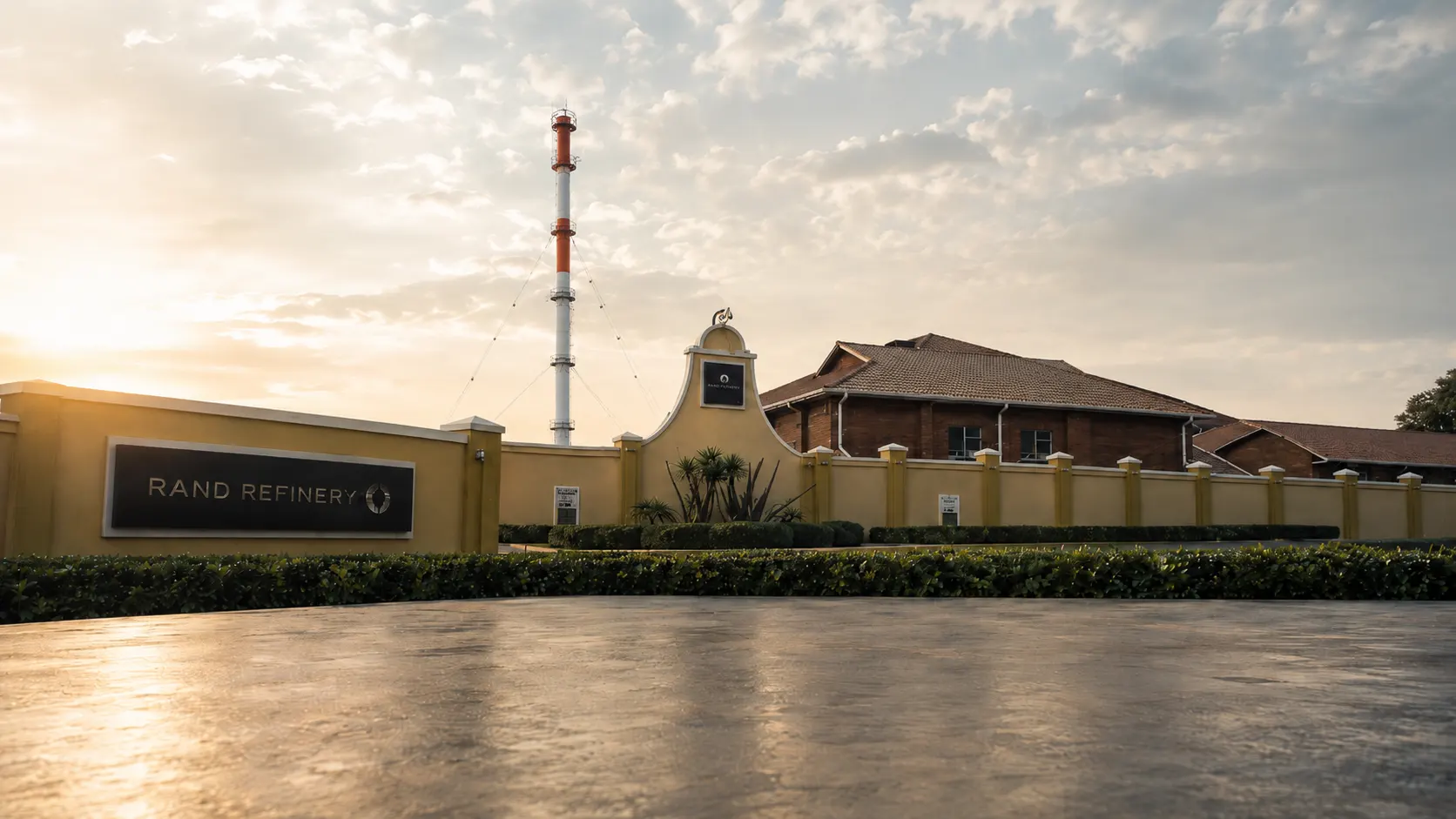
Rand Refinery is the only refiner in Africa on the LBMA Good Delivery List, and one of seven refiners the LBMA appoints as Referees — the laboratories that assess applicants to the List, monitor the refiners already on it, and adjudicate disputes over metal content between LBMA members. It has worked a single site in Germiston since 1921, refining doré, casting Good Delivery bars, and making the blanks the South African Mint strikes into Krugerrands. The hallmark reaches buyers at both ends of the market: on a 400-ounce cast bar entering a London vault, and on a one-ounce minted bar sealed in an assay card. That hallmark, and the serial number beside it, establish which bar this is and who cast it; fine gold content is established by assay, and the LBMA endorses no non-destructive method of doing that.
A refinery built to keep South African gold out of London
Before 1920, gold leaving the Witwatersrand left the country unrefined. Producers shipped crude bullion to London, where the Bank of England received the consignments and issued them to individual refineries, and where the charges and the delay were both set by parties on the other end of the shipment. The Chamber of Mines put an end to the arrangement by building its own facility. Rand Refinery Limited was registered as a private company on 27 November 1920, its capital subscribed by member gold mining companies; construction had already begun in August, and the plant was completed in December 1921.
Where the plant went was settled by two conditions that still describe the operation: Germiston sits inside the Witwatersrand mining district, and it had the rail capacity to receive from it. The refinery took low-grade ingots from the mines and brought them to 99.6 percent. The South African Reserve Bank bought the result and placed it on the London and Zurich markets.
Working the same ground for a century, the refinery brought smelting, refining, and fabrication into one integrated complex, and the feedstock stopped being domestic: Rand Refinery has sourced doré from outside South Africa since 1998, which matters because South African mine output has declined for decades while the plant has not shrunk with it. It remains the only refiner in Africa accredited on the LBMA Good Delivery List, and states accreditation to COMEX, TOCOM and the Shanghai Gold Exchange, meaning gold it fabricates is deliverable against contracts on those exchanges.
The founding purpose determines the product line. Rand Refinery was built to take what comes out of a mine and turn it into something a central bank will hold. Minted bars and coin blanks were added on top of that function decades later, with the retail packaging later still. Two dates bracket the order: 99.6 percent gold moving to the Reserve Bank from 1921, and doré arriving from beyond South Africa from 1998.
Accreditation and the referee panel
Since 1921 Rand Refinery has held accreditation on the LBMA Good Delivery List, which names the refiners whose bars settle a loco London transaction on their markings alone, without independent assay. Accreditation attaches to the refiner. A bar inherits it through two records: that the refiner sat on the List on the day the bar was cast, and that the custody chain has held the bar since.
Above the List sits a panel of seven. These refiners act as LBMA Referees and meet quarterly at the LBMA:
- Agosi AG and Argor-Heraeus SA — see German gold refining and Swiss gold bar supply
- Metalor Technologies SA, MKS PAMP SA, Gold Corporation (trading as The Perth Mint), TANAKA, and Rand Refinery (Pty) Ltd
When a refiner applies for the List, a Referee performs the technical assessment. Monitoring of the refiners already listed runs anonymously: bars are pulled and assayed while the producing refiner remains unaware of which sample is under test. Referees also adjudicate disputes over metal content between LBMA members, and that function is what separates a Referee from a well-regarded refiner — when two members disagree about what is inside a bar, a Referee laboratory settles it.
On its own site, Rand Refinery still describes itself as one of five Referees. The LBMA added Agosi and the Perth Mint to the panel, bringing it to seven. The count carries the substance of the brand’s standing: the same laboratory tier that arbitrates content disputes for the London market assays Rand Refinery’s own output, and Argor-Heraeus — the origin anchor for Golden Ark Reserve’s Swiss supply — sits on that panel beside it.
Monitoring is a condition of listing. A refiner that declines it is removed from the Good Delivery List and entered on the Former List; bars it cast while listed keep their status, and bars cast afterwards trade outside the Good Delivery system, hallmark unchanged. The LBMA maintains both registers and publishes them.
What the refinery casts and mints
From one site, Rand Refinery fabricates across the whole width of the market. Formats divide by who buys them and how they clear.
| Format | Fineness | Where it clears |
|---|---|---|
| Large cast bar, nominally 12.5 kg (~400 oz) | 995.0 minimum | Loco London settlement, exchange delivery, central bank reserves |
| Cast bars, 100 g and 1 kg | 999.9 | Dealer and vault inventory; Asian kilobar markets |
| Minted bars | 999.9 | Retail and small-institutional distribution |
| Coin blanks, including Krugerrand blanks | Alloy per the coin | Struck elsewhere; sold as coins |
Between 350 and 430 fine troy ounces: that is the envelope the Good Delivery Rules set for the large cast bar, at a fineness of 995.0 or above, with gross weight expressed in multiples of 0.025 of a troy ounce, rounded down. Each bar carries a serial number, the refiner’s stamp, the fineness to four significant figures, and — for bars cast from January 2019 — the month and year of manufacture. No two bars in a Good Delivery holding weigh the same. A list of ten of them is not 4,000 ounces; it is ten individually weighed and assayed fine contents, each priced at the same per-ounce rate and each contributing a different quantity. Anyone valuing an allocated 400-ounce position prices the bar list, not the count.
Cast to 999.9, a 1 kg bar holds 999.9 grams of fine gold — 32.1475 fine troy ounces against 32.1507 gross. The gap is three thousandths of an ounce. At scale it persists.
For the Krugerrand, the work divides between two institutions, though it is frequently reported as one. Rand Refinery manufactures the blanks. The South African Mint, the only entity permitted by law to strike South African legal tender, does the striking. Rand Refinery then distributes the bullion coin to primary dealers, an authority it has held since 1998. The coin is 22 carat, fineness 0.9167, alloyed with copper for durability. A one-ounce Krugerrand therefore weighs 1.0909 troy ounces gross and carries exactly one fine troy ounce of gold; the remaining 0.0909 of an ounce is copper, and the whole object prices as a coin, at a coin’s premium.
The retail brand and the wholesale bar
In 2023 Costco began listing one-ounce gold bars to its members, from Rand Refinery and from PAMP Suisse, and the search volume attached to the Rand Refinery name dates from about that point. The one-ounce minted bar drives it; the 12.5 kg cast bar is invisible to it. The company’s CFO told investors the listings cleared within hours of going live. Between September and November of that year Costco sold more than US$100 million of gold bars. Purchase limits per membership have tightened since. Costco operates no buyback.
Inside the packaging, the two bars carry different verification apparatus. The Rand Refinery bar carries a unique serial number and ships sealed in a black assay card. The PAMP Suisse bar ships with a digital certificate reachable by QR code, backed by Veriscan surface-mapping registered at the point of minting; both bars ship tamper-evident. One can be checked against a database the refiner holds; the other is checked by matching the number on the metal to the number on the card.
A sealed assay card certifies what the refiner recorded when the bar left the press, and that is the whole of what it certifies. An Allocation Record, a bar list, and a vault entry are produced elsewhere, by the custody chain. The card travels with the bar as a claim. At each change of hands the receiving party either accepts the claim or tests the metal: a dealer weighs the bar and matches its serial against the card, then reads the metal under XRF.
Buy a one-ounce sealed bar at a two-percent premium, sell it into a bid at spot minus one percent, and three percent of round-trip friction is absorbed before storage, insurance, or tax enter the calculation — friction that an allocated position avoids, because the bar stays inside the chain that vouches for it. Dealers price that friction into the bid. Observers tracking the Costco listings have put the retail premium at two to three percent of spot.
What authentication establishes — and what it does not
Every bar from an LBMA-accredited refiner carries the same four markings: a serial number unique within the refiner’s records, the refiner’s stamp, the fineness, and the year of manufacture. Retail bars add a tamper-evident assay card repeating those values. Read together, they answer one question with precision — which bar is this, and who cast it — and they answer it well enough that the loco London market transfers ownership by book entry without anyone opening a vault.
They do not establish fine gold content. The LBMA states the position without hedging: there is currently no definitive non-destructive testing solution it can endorse, and the only way to accurately determine the fineness of a gold bar is destructive testing of representative samples. Every method a buyer can apply to a bar without damaging it — XRF, ultrasound, conductivity, specific gravity — narrows the space of what the bar could be. None closes it. XRF reads a surface layer microns deep and a tungsten core sits well below that; ultrasound catches density discontinuities and misses a homogeneous alloy. Dealers run these tests on resale as a matter of course, and doing so is not an accusation. It is what the tests are for.
So a serial number is not a certificate of content. It is an index into a record, and the record’s value is the custody chain attached to it. A bar with a clean chain — refiner to LBMA-affiliated vault to allocated holding, each transfer logged against refiner, serial, gross weight, and fineness — is accepted on its markings, because the markings are corroborated at every point they passed. The same bar, physically identical, with a gap in that chain, is accepted on nothing. It re-enters as recoverable metal and prices at a refining discount until an assay says otherwise. Nothing about the bar changed. The record around it did.
This is why the practical question in front of a buyer holding a Rand Refinery bar is rarely about Rand Refinery. The refiner’s Good Delivery accreditation and its seat on the referee panel discharge the question of whether a bar of that hallmark, cast in that year, met the specification when it was cast. Whether this bar is that bar is a different question, answered by provenance rather than by metallurgy. Checking a bullion bar in the physical sense — marks, weight, dimensions, packaging integrity — is the first filter, not the last one.
Where a Rand Refinery bar sits relative to a deliverable line
Golden Ark Reserve contracts refinery-origin supply from Heraeus Precious Metals and Argor-Heraeus SA. Argor-Heraeus sits on the LBMA referee panel alongside Rand Refinery, under the same accreditation regime, the same monitoring, and the same Good Delivery specification. Golden Ark Reserve does not supply Rand Refinery bars.
What reaches a counterparty through that line is the wholesale object: 1 kg and larger cast bars, 400 oz Good Delivery bars, entering allocated storage against a bar list and moving under coordinated custody, carried by the documentation that makes the markings on them mean something. The one-ounce sealed card belongs to a different market with different mechanics.
Evaluating a physical position, a qualified counterparty starts from the format, the fine content, and the custody chain rather than from the hallmark. Purchase and allocation of refinery-origin bullion proceeds by request; there is no executable price on this page and none anywhere on this site.