

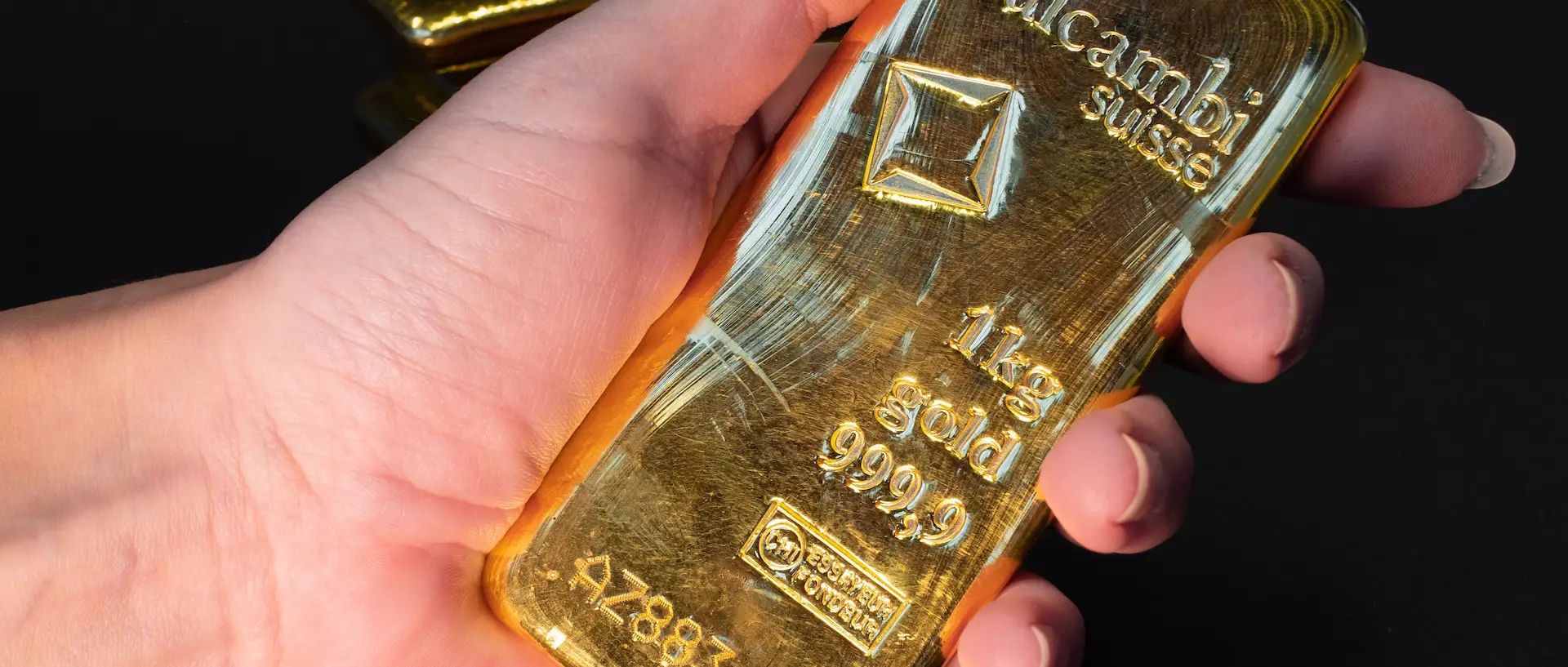
A Valcambi bar carries one of the most recognizable marks in the gold market, and that recognition was built rather than inherited. From a single plant in Balerna, in the Ticino canton of Switzerland, Valcambi spent decades turning a bar of fine gold into a mark that trades on its own name: first as the refinery behind the Credit Suisse bars that circulated worldwide, then under its own stamp, on the strength of Good Delivery accreditation and one of the largest refining operations in the industry. That standing travels with the bar into every transaction — a Valcambi bar trades at a premium over a generic bar of identical metal and fineness. And it cuts both ways: the recognition that commands the premium also makes the mark worth counterfeiting, so the same secondary-market bar draws buyers who want it and buyers who will not accept it without checking the serial number and assay card. Neither response is about the metal — both come from the bar around it: how the name was built, how each bar is made, and how a single piece is verified.
Company history and ownership
The mark on a Valcambi bar carries roughly six decades of fabrication and three changes of ultimate ownership, and neither fact is incidental to how the bar trades. The recognition a buyer leans on at resale and the due-diligence questions a counterparty raises about the refiner both trace back to who built Valcambi and who controls it now.
Founding as Valori & Cambi (1961)
Valcambi began in 1961 in Balerna, a town in the Ticino canton on Switzerland’s southern border. Five private Swiss investors set it up under the name Valori & Cambi — literally “exchange of valuables” — trading precious metals and banknotes. Refining and bar fabrication grew out of that dealing rather than preceding it. The company contracted the two words into the name Valcambi in 1967. The relationship that shaped the bar’s later standing arrived with its first major counterparty.
The Credit Suisse era
In its early years the refinery could not meet demand on its own metal. The working solution was a gold-lending arrangement with Credit Suisse. Valcambi borrowed physical gold each morning — on the order of 200 kg a day — and returned it the same evening as finished kilo bars. The arrangement deepened into ownership. Credit Suisse took a 50% stake in 1967 and a further 30% about eighteen months later, and held the company until 2003.
For a buyer, the operational residue of that period is twofold. First, Valcambi was the refiner behind the Credit Suisse–branded bars that circulated worldwide. A Credit Suisse bar met on the secondary market today is Valcambi fabrication; the two names share one production lineage, which matters when an older bank-branded bar surfaces in an allocation. Second, it was through Credit Suisse ownership that Valcambi’s products were granted COMEX and LBMA Good Delivery status — the accreditations that let the metal settle between wholesale counterparties without re-assay. Both the premium a Valcambi bar commands and its broad secondary-market recognition were established in this period.
Newmont and the Rajesh Exports acquisition
After Credit Suisse exited, Valcambi was held through European Gold Refineries Holding. The US miner Newmont Mining held the majority — about 60% — alongside private-equity holders, an arrangement that ran until 2015. In July 2015 the company passed to Rajesh Exports, an Indian gold group. It sits under Rajesh Exports today through a holding chain — Global Gold Refineries above European Gold Refineries — while refining and management remain with the Swiss operating company in Balerna.
Through all three ownerships, the operating layer stayed put. Good Delivery accreditation, the assayer and melter licences, and the fabrication line all attach to the Swiss operating entity, not to the parent above it. So the changes of ultimate owner — bank, miner, jewellery group — neither interrupted the bars’ standing nor reset their serial records. For a counterparty that reads as provenance to document, not a discontinuity to price.
Refining operations and bar formats
From a single 3.3-hectare site in Balerna, Valcambi refines a combined roughly 2,000 tonnes of gold, silver and platinum-group metals a year — among the largest dedicated precious-metals refineries by annual throughput. The plant runs the full sequence in one location, from refining and assaying through to finished cast and minted bars, and it automated kilobar production as early as 1994. For a counterparty, the operating value is standardization at volume. High-throughput, serial-numbered output is produced under the refiner’s own assayer and melter licences, not in bespoke runs, which is what lets identical Valcambi bars substitute for one another inside an allocation.
Cast vs minted gold bars
Valcambi gold bars divide into two production methods, and the split governs both finish and how a bar moves on the secondary market. Cast bars are poured molten into molds. They take a broader form with rounded edges and the design struck incuse into the surface. Minted bars are pressed from cast strip, giving sharp edges and raised relief detail. The documented gold ranges sit close together. Valcambi lists minted ingots from 1 g to 1,000 g, and cast bars run from 50 g to 1,000 g, customizable in all finenesses subject to a minimum order.
| Cast | Minted | |
|---|---|---|
| Production | poured into molds | pressed from strip |
| Surface / edges | incuse design, rounded edges | relief design, sharp edges |
| Documented gold range | 50 g – 1,000 g | 1 g – 1,000 g |
| Secondary-market handling | loose bars invite weight/assay confirmation | sealed card with matching serial verifies on sight |
In handling, the two diverge. Minted bars arrive security-sealed in PETG blisters or capsules, each with a certificate carrying the bar’s serial number. A sealed minted bar therefore clears on sight, while a loose cast bar invites weight and assay confirmation before it settles. The kilobar sits at the top of Valcambi’s documented range, and it is the size that maps most directly to the institutional gold bar formats a qualified buyer transacts in. The smaller minted sizes serve investor-scale holdings, and the divisible products below sit in retail distribution.
The CombiBar and specialty formats
At the retail end sits the CombiBar, a single bar scored into segments that snap apart by hand, each piece individually hallmarked and tradeable at metal value. It comes in several gram-scale formats and ships sealed, with assay certification for the whole bar and for each divisible piece. That divisibility carries a per-gram premium over a solid bar of the same weight, which sets its purpose: small-denomination distribution and sale in pieces. For an institutional buyer holding for reserve or resale, the CombiBar falls outside the bar set — divisible retail formats do not move through Good Delivery handling.
Accreditations and market standing
Valcambi has supplied the London market since 1968, and its gold and silver bullion carry LBMA Good Delivery accreditation. Good Delivery is the LBMA’s specification for the physical gold and silver bars that settle in the wholesale London market. Listing requires a refiner to meet exacting refining and assaying standards and to be financially stable. The payoff is the one a counterparty cares about most. An accredited refiner’s LBMA Good Delivery gold bars move between counterparties and into exchange and vault systems on their markings and the refiner’s standing, with no fresh assay each time the bar changes hands. That is what the Valcambi mark buys a holder — not better metal, but acceptance without re-testing.
The reach extends past London. Valcambi bars have been accredited for COMEX and CME Group settlement since 1974, originally under the Credit Suisse brand. Bars from the major listed refiners are also accepted against Tokyo Commodity Exchange contracts, the Dubai (DMCC) Good Delivery list, and Shanghai Gold Exchange standards. Each additional list widens where a Valcambi bar can be delivered physically, and that breadth is the practical basis for its fungibility on the secondary market.
In platinum and palladium, Valcambi’s role runs further than a listing. It holds LPPM Good Delivery accreditation and sits on the LPPM’s five-member referee panel, which means it helps assess applicants and monitor other refiners’ PGM bars. In gold, though, it is a listed refiner, not one of the LBMA’s gold Good Delivery referees — a distinction easy to overstate and worth keeping straight. Beneath the trading accreditations sits a quality layer. Valcambi’s laboratory received METAS accreditation in 1995, the first refinery laboratory to do so, alongside ISO 9001 and ISO 14001 certification; the LBMA Responsible Gold Certificate followed in 2013. And Good Delivery is not a one-time badge. Listed refiners that drop out of the monitoring regime are removed and moved to a Former List, so a refiner currently on it is under active assay and solvency oversight. Confirm a bar’s listing status, then — not its age.
Authenticating a Valcambi gold bar
Before a Valcambi bar clears on sight, three things have to agree — the markings on the metal, the certificate sealed with it, and the records behind the serial number. Miss or break one link and the bar does not stop being gold. It stops clearing on sight, and the burden shifts to independent assay and a price discount.
Bar markings
A genuine Valcambi gold bar carries a fixed mark set. The obverse shows the Valcambi Suisse name and logo, the metal and weight, the fineness, and a unique serial number. On a minted bar the reverse repeats the company name, and the assayer-melter hallmark “Essayeur Fondeur” sits above the serial. That hallmark is not decorative. Its presence records that the bar was assayed and cast by Valcambi, under the refiner’s own assayer and melter licences. Fineness is the fastest first-pass tell — Valcambi investment gold is .9999, so a bar presented as Valcambi gold but stamped .999 is wrong on its face. On wholesale bars these marks are mandatory rather than conventional. An LBMA Good Delivery bar must carry a serial number, the refiner’s hallmark, the fineness, and the year of manufacture, and retail minted bars follow the same pattern. One caveat keeps a genuine bar from being failed. Older standard minted bars may show only the Valcambi name on both faces, so a thin mark set on an old bar is not disqualifying on its own.
Assay certificate and tamper-evident packaging
Minted bars ship sealed. Each is secured in a PETG blister or capsule with a certificate carrying the serial number, the weight in grams, the fineness, and Valcambi’s certified assayer hallmark. One detail trips up buyers who expect a hand-signed document. Valcambi certificates carry no individual signature, because the assayer and melter licences are issued to the company, not to a named person, so no personal signature is legally required. Reading an unsigned certificate as a defect is a false negative; the certified-assayer hallmark, not a signature, is what stands behind it. The seal matters too. A bar still in its original blister with a matching serial clears with little friction, while a bar sold loose, outside its card, should be priced accordingly or set aside until independently checked. For a CombiBar the paperwork scales with the format, with an assay certificate for the whole bar and one for each divisible piece.
Serial-number verification and secondary-market checks
On a Good Delivery bar, the serial number is the identifier that tracks a single bar between vaults, banks, and counterparties. That makes verification a matching exercise rather than a judgment call. The number on the metal, on the assay card, and on the purchase invoice must agree, and the serial can be checked against Valcambi’s records. Counterfeits fail this in one of two ways — a duplicated or invented serial that does not reconcile, or a physical bar that misses its published weight and dimensions. Counterfeiting concentrates on the most-traded retail sizes, the one-ounce in particular. For a higher-value acquisition, or any bar arriving without intact packaging, the sequence is fixed. Confirm the markings. Weigh and measure against the published specification. Reconcile the serial across bar, certificate, and invoice. Where any of those is absent, the bar goes to independent assay before it settles, not after.
Valcambi bars in institutional allocations
A qualified buyer rarely sets out to acquire “a Valcambi bar.” More often the mark turns up inside a position assembled for weight and fineness — a Good Delivery allocation in which bars from several accredited refiners sit interchangeably, each tracked by the serial that follows it between vaults, banks, and counterparties. Valcambi’s place there follows directly from its accreditation. Because Good Delivery fixes uniform physical characteristics across listed refiners, its gold moves into and out of allocated holdings on the same footing as any other listed refiner’s metal. A mixed-refiner vault position is the ordinary way an institution comes to hold it.
That interchangeability reframes the premium. Within Good Delivery the metal is fungible regardless of which accredited refiner cast it, so the recognition a Valcambi bar carries is a cost the buyer weighs, not a property of the gold. An institution acquiring physical gold for reserve exposure is buying weight and fineness. The brand premium sits on top and buys recognition, which has resale value but is a choice taken knowingly. In practice the mark splits buyers. One who needs the recognized name pays for it; one who needs the weight treats the same premium as overhead.
Where the choice has teeth is provenance. The verification chain that clears a single bar is the same control that decides whether a Valcambi bar enters an allocation at full value. A sealed minted bar with a reconciling serial books clean. A loose bar, or one offered below the secondary-market range, carries assay cost and discount risk before it can be entered at weight — and that risk is highest at the most-traded retail sizes, the one-ounce in particular, exactly where the bars are most common. For institutional intake, packaging integrity and serial reconciliation are an intake control, not a collector’s nicety.
At exit, the same discipline pays back. Recognition that commands a premium also shortens the path to a sale. A Good Delivery Valcambi bar with intact documentation and a reconciling serial exits through gold buyback with little friction. The same bar stripped of its card and certificate re-enters the assay-and-discount cycle at the worst possible moment, when the holder is trying to realize value. The bar verified carefully at acquisition is the bar that exits cleanly; the work happens at intake, and the exit only collects on it.
Across the whole arc, the Valcambi mark settles one question — acceptance — and leaves two for the buyer: whether the position needs the name or only the weight, and whether this particular bar verifies against its markings, its certificate, and its serial. Answer both, and the bar enters an allocation at full Good Delivery value, on the same terms as any other listed refiner’s metal; leave either open, and it enters at a discount or not at all.