

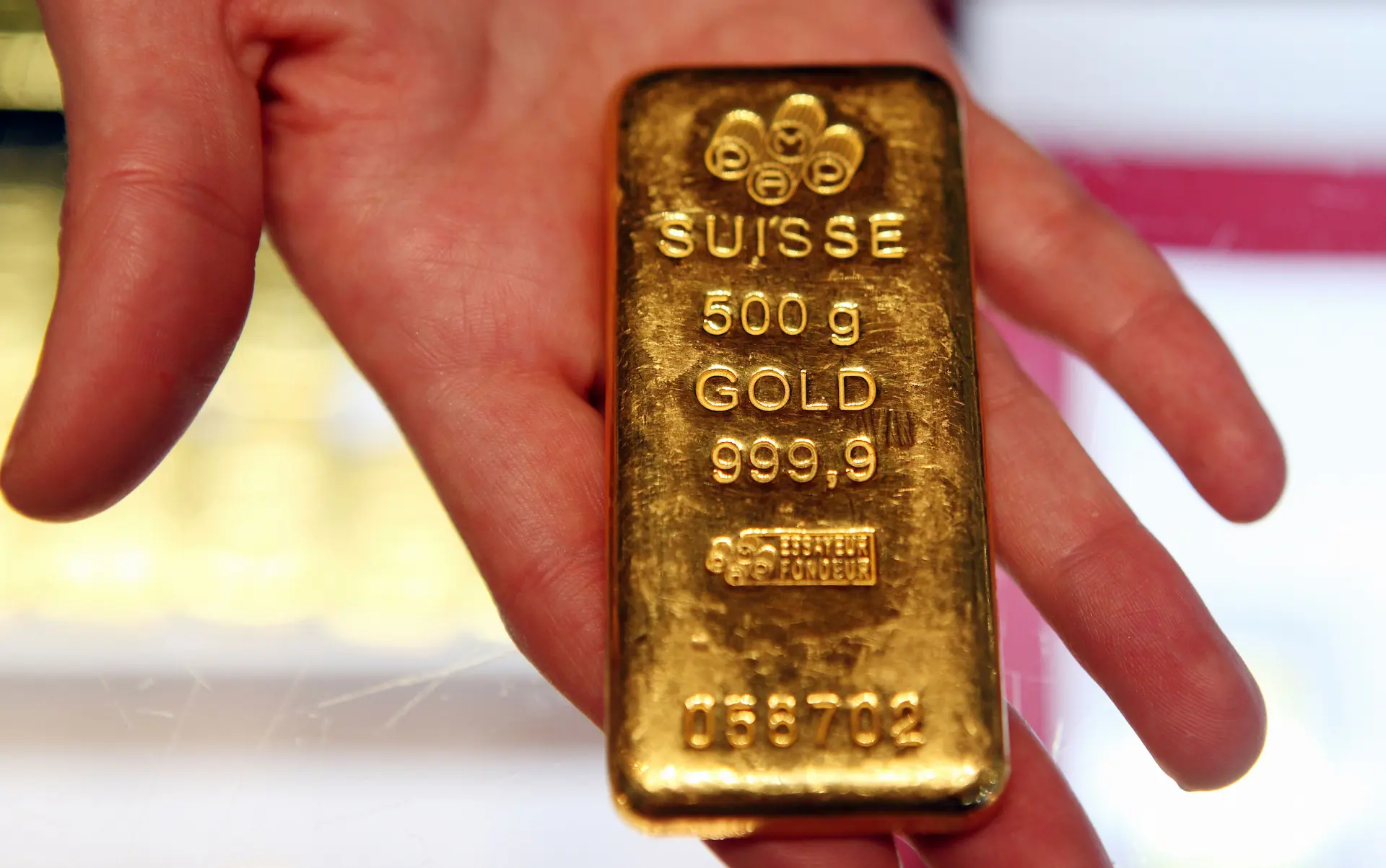
A PAMP Suisse bar is among the most recognized objects in the gold market, and that recognition has a specific history. From a single refinery in the Ticino canton of Switzerland, PAMP turned a commodity — a bar of fine gold — into a brand: first through a decorated minted design that was new to the bullion bar, then through accreditation that placed it among the small panel of refiners the London market treats as a reference standard. That standing now travels with the bar into every transaction — a PAMP bar trades at a premium over a generic bar of identical metal and fineness. And it divides buyers: some want the name specifically and pay the premium for it, while others now approach the same bar with caution. Neither reaction is about the gold — both come from the bar around it: how the name was built, how each piece is made, and how it can be checked.
PAMP Suisse and the MKS PAMP Group
PAMP — Produits Artistiques Métaux Précieux — is a precious-metals refinery in Castel San Pietro, in the southern part of the Swiss canton of Ticino. It refines and fabricates gold, silver, platinum, and palladium, and its investment-grade gold bars carry a fineness of 999.9. The name stamped on a bar, PAMP or PAMP Suisse, is the brand of this one refinery, which operates today as the subsidiary PAMP SA inside the MKS PAMP Group, a Geneva-based refining and trading house. A counterparty record or assay document that reads “MKS PAMP” points to the same entity behind the mark.
For large bars to settle in the loco-London market, a refiner must hold LBMA Good Delivery accreditation, which PAMP carries; its bars are also accepted under the good-delivery regimes of the Swiss National Bank, the DMCC in Dubai, COMEX, and several Asian exchanges. It also helps run the standard. As MKS PAMP SA, it is one of the small panel of refiners LBMA appoints as Good Delivery referees — seven as of 2025. The referees assess refiners applying to the list, monitor those already on it, and advise on the technical rules. For a buyer weighing whether the metal behind the brand is sound, that is the operative point: the refinery sits at the tier that sets the test other refiners are measured against.
History: from a Ticino refiner to a global bullion brand
PAMP was founded in 1977, when Mahmoud Kassem Shakarchi — a gold trader who had worked in Beirut before moving to Switzerland — set up a small refinery in Ticino making minted gold bars, sold mainly into Middle Eastern markets. Southern Ticino was a deliberate base: PAMP, Valcambi, and Argor-Heraeus all refined there to supply the Italian jewellery trade, then among the largest gold-jewellery markets in the world — the cluster of Swiss refiners that still anchors physical supply today.
The step that turned a regional refiner into a recognized brand came in 1979, with the Lady Fortuna design — the first decorative motif applied to a minted gold bar. The bar carries the figure of the Roman goddess on one face and its weight, fineness, and a unique serial number on the other. The design was not ornament for its own sake: a distinctive, hard-to-reproduce motif made a PAMP bar identifiable on sight and more difficult to copy, and the Fortuna series became the format most buyers picture when they picture a PAMP bar.
The corporate structure formed in the same window. Shakarchi founded MKS (Switzerland) SA in Geneva in 1979 — the initials are his — and the trading house took a majority shareholding in PAMP in 1981, pairing PAMP’s refining with MKS’s distribution. The two were merged into a single company, MKS PAMP, in November 2021. Bars and paperwork predating that merger carry the earlier PAMP SA identity; both trace to the same refinery.
By the time a PAMP bar reaches a buyer today, that history is doing two things at once. The recognition built since 1979 supports the resale premium the bar commands, and that same recognition is what makes it worth counterfeiting.
How PAMP gold bars are produced
PAMP issues gold in two physically different forms, minted and cast, and the form changes how a bar is made, what it costs over its metal content, how it is packaged, and how a buyer checks it. PAMP produces both across an overlapping band of weights, so for most mid-range sizes a buyer can choose between them; only at the extremes does the form follow the size.
Minted bars and the design range
A minted bar starts as cast metal that is rolled into a flat strip, cut into blanks sized to weight, and struck under a press that stamps the design and the markings — weight, fineness, serial number — in one operation, followed by annealing, polishing, and inspection. The output is uniform to tight tolerances: sharp edges, a flat polished surface, and a weight tolerance tighter than a cast bar’s. The Lady Fortuna series, with its proof-like field, is the principal minted line, though PAMP mints other designs and a range of small formats from sub-gram weights up through 1 kg.
That fabrication is what the minted premium pays for. A minted bar costs more to produce than a cast bar of the same weight and purity — more tooling, more processing steps, more handling — and it ships sealed in a CertiPAMP assay card rather than loose. The return on that cost shows up at resale: a sealed, uniform minted bar is verifiable on sight and tends to change hands closer to the spot price, where a bar taken out of its card may need inspection or assay before a buyer will pay full value. The premium is steepest on the smallest bars, because the fixed cost of fabrication and packaging is spread over less metal — a small minted bar can trade at a double-digit percentage over spot while a kilogram bar sits far lower.
Cast bars
When a bar is cast, molten gold is poured into a mould, left to cool, and stamped with its markings on the solidified surface. The result is less uniform than a minted bar — visible pour lines, rounded edges, surface variation, a wider weight tolerance — and it costs less to make, so it carries a lower premium and delivers more gold per unit of outlay. Casting is the method used for the largest formats. PAMP’s cast gold runs from 50 g up to the 400 oz bar that meets the LBMA Good Delivery weight band, the form in which gold moves at the wholesale and institutional tier. The surface that makes a cast bar look rough is also individuating — no two pour patterns are identical — which is one reason large cast bars are tracked by serial and weight as individual objects rather than as interchangeable units.
Fineness and the refining standard
At a fineness of 999.9 — 99.99% gold, four nines — PAMP’s investment gold bars sit above the LBMA Good Delivery floor, which sets the minimum acceptable fineness for a wholesale gold bar at 995.0 parts per thousand: “Good Delivery” certifies that a bar clears that floor and the standard’s weight and marking rules, not that it reaches 999.9. That distinction shows up in the numbers. Fineness is stamped to four significant figures, and a bar’s fine-gold content is its gross weight multiplied by that stamped fineness — so two bars of equal gross weight differ in value whenever their fineness differs.
Bar formats, packaging, and documentation
A PAMP purchase resolves to a defined object: a specific weight, in minted or cast form, carrying documentation that travels with the metal. The two forms cover different parts of the weight range, and the packaging differs with them.
| Form | Weights | Packaging | What travels with the bar |
|---|---|---|---|
| Minted | Sub-gram to 1 kg (incl. 1 g, 5 g, 10 g, 20 g, 50 g, 100 g, 1 oz) | Factory-sealed CertiPAMP assay card, tamper-evident | Integrated assay certificate — assayer’s signature, serial number, weight, 999.9 fineness; Veriscan-registered |
| Cast | 50 g to 400 oz (incl. kilobar; regional Tael and Tola weights) | Larger bars supplied loose | Separate assay certificate; serial number and markings struck into the bar |
The CertiPAMP card on a minted bar is the documentation, not a wrapper around it. The bar is held behind a removable film in a card that carries its assay details and a unique serial number, and the seal is the operative part: while it is intact, the card certifies the enclosed bar’s weight and fineness, and a dealer can accept it without re-assay. Break the seal and the bar is still genuine, but it has left the condition the certificate was issued for — it may now need inspection or assay before it trades at full value, which is why sealed minted bars resell more readily than loose ones.
For cast bars, the documentation works differently. The largest formats — the 400 oz Good Delivery bar and the kilobar — are handled as individually weighed and assayed objects, identified by the serial number and markings struck into the metal and accompanied by their own certificate rather than a sealed card. At that tier the bar’s identity rests on its record and its markings — the chain a vault or counterparty checks against — not on an unbroken consumer seal.
The minted-or-cast split and these weight bands are common to LBMA refiners generally; the formats Golden Ark Reserve coordinates are set out in its gold-bar range.
Authenticating a PAMP gold bar
PAMP’s recognition is what makes its bars worth faking, and counterfeits — both fake bars and genuine-looking fake packaging — are the reason some buyers now treat a PAMP bar with caution. The design is the first thing a counterfeiter reproduces, so the look of a bar proves little on its own. What proves a specific bar is verification, and PAMP supplies three layers: the sealed assay card, a surface record held in PAMP’s database, and the markings on the bar itself. Each confirms something a buyer needs before paying the premium, and each has a limit the others cover.
The CertiPAMP assay card and tamper-evident seal
Inside its CertiPAMP card, a minted PAMP bar sits behind a removable film, and the card carries an integrated assay certificate — the assayer’s signature, the bar’s weight and 999.9 fineness, and a serial number. The first check is internal consistency, that the serial on the bar matches the serial on the card; while the seal is intact the card certifies the enclosed bar and a dealer can transact on it without re-assay, and a broken or resealed film voids that certainty. The card has one failure mode that matters, though: it can itself be counterfeited. A convincing fake card around a fake bar reproduces the layout and serial format closely enough that a buyer who checks only the packaging can be deceived — the card establishes what the bar should be, not, on its own, that the metal inside is the bar PAMP made. That is the gap the next layer closes.
Veriscan surface authentication
Veriscan ties a bar to PAMP’s production record through the metal itself. Every struck bar has a microscopic surface texture unique to it, the way a fingerprint is; the producer scans that surface on the production line and stores it in a central database. Afterward, anyone can scan the bar with the Veriscan app, and the software compares the live scan against the stored record, returning a pass for a registered bar or a fail for one it cannot match. The scan reads the bar’s own surface, not a code printed on the card, so it works whether the bar is sealed in its CertiPAMP packaging or out of it, and larger bars can be read on all six sides. The check is non-destructive — the bar is left intact and can be resold at once.
Two properties make this the strongest of the three layers. The first is independence from the packaging — the scan turns on the metal alone, so only a registered bar passes, and a fake card around a fake bar changes nothing; a Veriscan pass tells a buyer the operative thing, that this specific bar is one PAMP produced and recorded, not a copy of one. The second is external validation. In 2023 the underlying technology, AlpVision, received LBMA Security Feature accreditation under the Gold Bar Integrity programme, the supply-chain initiative it runs with the World Gold Council.
Serial number, assayer mark, and manual checks
On the bar itself, the markings are the layer that needs no app. It carries a serial number unique within PAMP’s records, the refiner’s stamp, and its fineness; the serial is the thread that should tie the bar to its certificate and, through Veriscan, to the production database. Without equipment, the checks available are matching that serial to the certificate, weighing the bar against its stated tolerance, measuring its dimensions, and reading the design detail and edges, where copies tend to fall short of a struck original. None of these is conclusive alone, but together they screen out crude fakes.
Where surface checks run out — a bar of correct weight and dimensions with a non-gold core — the standard itself draws the line. Non-destructive instruments narrow it. Ultrasound and electrical-conductivity tests can expose a core of a different metal, and XRF reads composition but only at the surface; none confirms fineness outright. As LBMA states, the only way to determine a gold bar’s fineness with certainty is a destructive fire assay of a drilled sample — which is why the wholesale market relies on chain of custody rather than re-assaying every bar: a bar that has stayed within that system, sealed and recorded, is accepted on that record. For a PAMP bar, the working authentication is the combination — serial and markings, the sealed card, a Veriscan pass, and a provenance that runs back to an authorized source.
PAMP within the LBMA Good Delivery system — and sourcing investment bullion
Everything in the preceding sections — the referee status, the 999.9 fineness above the 995.0 floor, the markings, the chain of custody — converges on one standard: LBMA Good Delivery. That accreditation is what an institutional buyer actually transacts against. A bar that carries it settles in the loco-London market, is accepted by counterparties who will never physically inspect it, and moves between vaults on its record rather than on re-assay. The standard is what makes an allocated gold position fungible at the wholesale level, and PAMP is one of the seven refiners that, as referees, help administer it.
For a buyer operating at that tier, a distinction follows. What clears the wholesale market is the standard and the custody record; the refiner’s brand is secondary to both. A PAMP bar and one from another accredited refiner, matched on specification and provenance, settle on the same terms — the premium described earlier sits on top of the metal as a recognition premium, and is not a condition of its acceptance. A buyer who needs the brand pays for it; a buyer who needs Good Delivery gold in allocated, deliverable form is choosing on the standard, and there the refiner is one input among several.
That is where a PAMP enquiry and Golden Ark Reserve meet. Golden Ark Reserve is a trading counterparty — not a refiner, and not a PAMP distributor — whose supply is refinery-origin gold from Heraeus and Argor-Heraeus, the latter sitting on the same Good Delivery referee panel as PAMP. The firm coordinates LBMA Good Delivery bars in allocated form, with allocated storage coordinated through Brink’s and international delivery, for qualified counterparties. A reader who came to weigh the brand and concludes that the operative requirement is Good Delivery metal — allocated and deliverable, rather than a specific mark — can acquire it through Golden Ark Reserve.