
Good Delivery List Suspension: What Happens to Bars
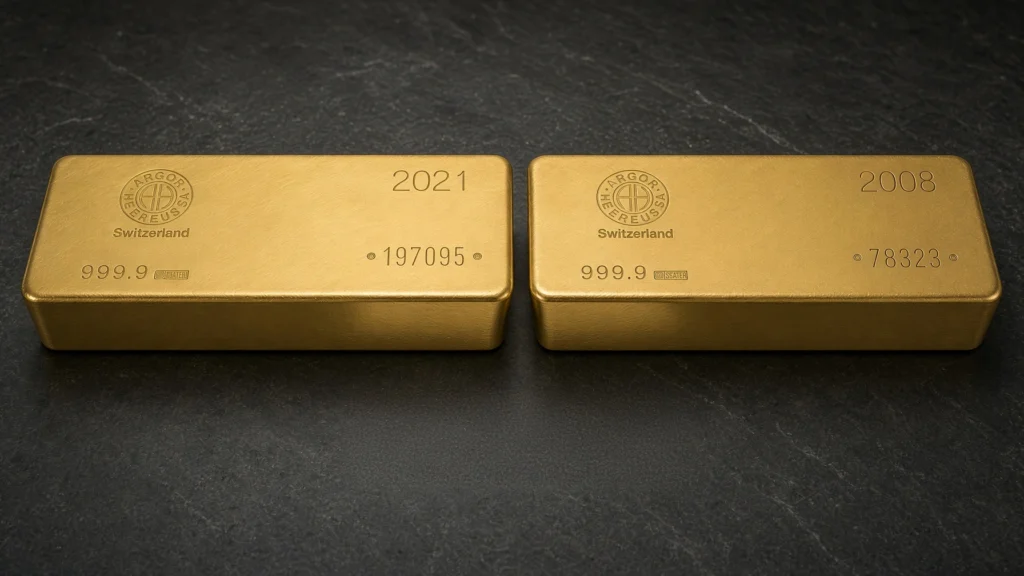
A 400-ounce gold bar can pass between banks, vaults and owners for decades without anyone assaying it. It travels on the refiner’s mark. LBMA lists the refiners whose bars met its standard when first tested and keeps monitoring them afterwards, so a bar carrying a listed mark is accepted without a fresh assay. Once the bar is bought and allocated, its refiner shrinks to one column on a bar list, next to the serial number, weight and fineness.
In August 2026 that column became worth reading again. Within three weeks LBMA suspended two refiners from its Good Delivery Lists, one of them from the gold list. Neither notice said what happens to bars cast before the suspension took effect — the bars already sitting in vaults and on bar lists.
LBMA’s Good Delivery List Rules answer that question bar by bar. The answer depends on when each bar was cast and on what LBMA decides after the notice, sometimes many months later. The marks on a bar and the records that travel with it usually show which side of the effective date it was cast on. Getting that wrong costs money either way: a swap of metal that still qualifies, or a delivery the receiving party is entitled to refuse.
What a Good Delivery List suspension changes
The Good Delivery standing of a bar traces back to one entry on the List: a refiner at a specific location, accredited after its bars passed LBMA’s tests and reviewed at intervals ever since. A suspension acts on that entry.
In LBMA’s Good Delivery List Rules, the definition of a suspension runs to two sentences. A refiner that falls short of the Rules may have its Good Delivery status suspended until the matter is resolved to LBMA’s satisfaction, and while the suspension lasts its new production is not considered Good Delivery. Bars cast before the suspension go unmentioned. The definition draws its line at production, which turns the effective date in a notice into the boundary between one bar and the next.
Once LBMA has decided, at its discretion and after a review process, the market learns of it from a notice naming the refiner and the date from which the suspension applies. Much of what leads there stays out of view. Refiners report production and net worth to LBMA in strict confidence, Proactive Monitoring assays are compared in confidence, and LBMA may keep an incident review confidential until the issue is resolved. A holder watching from outside usually learns of a problem when LBMA acts on it.
Routes into a suspension
Each notice also says why LBMA acted, and the Rules give it several routes to the same result. Some work like tripwires, set off by something a refiner failed to do: two consecutive failed rounds of Proactive Monitoring bring an immediate suspension, while an annual fee still unpaid after 90 days, or a refusal to send bars back for retesting, can end the same way.
Where production or capital is the weakness, the path is slower. LBMA reads both on a three-year moving average against minimums of 10 tonnes of gold a year and £15 million of tangible net worth, and a refiner that keeps falling short passes through a watch list and a remedial plan before anything happens to its entry.
Once a year, responsible sourcing works as a gate of its own. Every refiner must be audited annually by an approved provider to stay on the List, and LBMA publishes the reports alongside its entry. A refiner on the silver list, Hunan Shuikoushan Nonferrous Metals Group (SKS), was suspended from 21 August 2026 after its assurance provider issued a modified opinion on its FY2025 Responsible Silver compliance report.
An Incident Review Process runs on a separate track. LBMA opens one when reports, a grievance or official action raise questions about a refiner’s reputation, and the outcome can range from a special review or a corrective action plan to suspension or transfer to the Former List. Opening a review leaves the listing untouched. The listing changes only when LBMA announces an action, which can come before the review is finished.
That is how the gold list changed in August 2026. On 4 August LBMA opened a review into Shandong Gold Smelting Co. Ltd after the company was added to the United States Uyghur Forced Labor Prevention Act (UFLPA) Entity List. As an interim measure, without prejudice to the outcome, it suspended the refiner from both the gold and silver Good Delivery Lists from 5 August. Shandong Gold Smelting has told LBMA that it rejects the designation and welcomes an independent review under the Good Delivery Rules and the Responsible Sourcing Programme.
Whatever the route, the ground written into the notice outlasts the suspension itself: the Rules return to it when the case closes.
Sorting bars against a suspension notice
Turning a notice into a list of affected bars takes four checks. Their order matters, because each one lets some bars drop out before the next is needed.
- Format. The Rules govern large bars: gold bars holding between 350 and 430 ounces of fine gold at a minimum fineness of 995.0. Kilobars and smaller bars from a listed refinery bear the same stamp, yet the Rules give them no Good Delivery status. A suspension reaches them only through the standing of the refiner named on the stamp, and any market that refers to the List for smaller formats applies whatever rule it has set.
- Refinery. The stamp identifies the refiner, with its location where that is needed to tell entries apart, and a vault bar list repeats that identity in its brand column against each serial number. Because each location is a separate entry on the List, the match runs against the exact entry the notice names. Before the bar list is trusted for this, matching each serial number on it to the bar it describes confirms that list and metal agree.
- Cast date. Since January 2019 every Good Delivery bar has carried its month and year of manufacture as MMYY, stamped separately or worked into the first four digits of the serial number, and the weight list that accompanies bars into a vault repeats it in a dedicated column. A bar with no such mark was cast before the 2019 rule, which puts it ahead of any suspension announced since.
- The boundary month. The stamp records a month, while a suspension starts on a named day. Bars stamped with the month in which a suspension took effect can therefore fall on either side of it, and neither the stamp nor the weight list can say which. Only production records can, and until they are in hand those bars stay unresolved.
Run against a notice on the day it appears, the sort places nearly every bar already held on the earlier side of the effective date. Those bars keep their standing while the suspension lasts. LBMA’s next decision on the refiner settles whether they keep it afterwards.
What can still change for bars cast before the suspension
By design, a suspension is temporary. LBMA either restores the refiner’s status once the matter is resolved or transfers the refiner to the Former List, and bars cast before the effective date wait out the suspension with their standing intact.
| Stage | Bars cast before the suspension | Bars cast during the suspension |
|---|---|---|
| Suspension in force, for up to twelve months | Keep Good Delivery status | Not Good Delivery |
| Matter resolved, refiner reinstated | Keep Good Delivery status | Sanctions ground: remain outside Good Delivery. Other grounds: LBMA decides |
| Transfer to the Former List: twelve months unresolved, a repeat suspension within five years, or an LBMA decision with immediate effect | May still be considered Good Delivery, unless the transfer rests on a Responsible Sourcing breach or on trade and economic sanctions | Remain outside Good Delivery |
| Former List, production ceased | LBMA may de-list them after an appropriate period | — |
The exceptions attached to a transfer account for most of the risk that earlier bars face. They follow grounds on which the Rules connect a refiner’s standing to the metal itself. The Responsible Sourcing Programme exists to exclude human-rights abuse, conflict and money laundering from a listed refiner’s supply, and the sanctions rule requires every Good Delivery bar to be deliverable to anyone, and holdable by anyone, without breaching a sanctions list. When a transfer is grounded in either, the Rules withhold the provision that would otherwise let earlier bars retain their status after the transfer.
Hindustan Zinc shows how far a reinstatement can reach back. LBMA reinstated the refiner in October 2022, two and a half months after suspending it under the Responsible Sourcing Programme, and recorded the silver refined during the suspension as Good Delivery. The Rules exclude that outcome where a suspension rests on trade and economic sanctions: output from the suspension period stays outside Good Delivery even after the refiner returns.
From the effective date, the twelve months in the table begin. The Rules also let an incident review close with a transfer of immediate effect, at any point in those months and whatever the refiner’s earlier suspension record. The two August 2026 cases reach the twelve-month mark in August 2027 unless LBMA acts sooner.
Where a bar’s status is tested
Good Delivery status is a condition of settlement. Physical settlement of a loco London gold trade is made in bars that meet the Good Delivery specification, so the question of status comes up when a bar is tendered, delivered into a clearing vault or sold into a market that settles against the List.
At a London clearing vault, the manager decides which bars to accept, with complete discretion over whether they meet the physical standard. The receiving party may refuse any bar the manager considers below the Good Delivery standards, and a bar cast during a suspension comes to that test with no status to show.
Those cast before the suspension remain Good Delivery, with the cover of the London rule on brands. Under that rule the delivering party chooses the brand it tenders, subject to any express term the two sides have agreed. The delivering party can therefore tender them while their refiner is under a suspension notice, and the receiving party pays for melting, refining or swapping if it declines them, unless the contract provides otherwise.
Refiner exposure moves into the delivery terms as a result. The receiving party enforces its refiner policy at the vault through those terms. Before the trade, the parties have to agree expressly to exclude the suspended refiner’s bars, including bars cast before the suspension.
Checking bars held through Golden Ark
Holding through an intermediary adds the intermediary’s own records to every check, and those records have to identify each bar as precisely as its stamp does. Bars sold by Golden Ark Reserve are cast or minted by Heraeus or Argor-Heraeus SA. They are allocated by serial number to a dedicated client sub-account at Brink’s Hong Kong or Singapore, named to the client in the vault register and segregated from Golden Ark’s own stock. Golden Ark sells the metal and keeps the record of which bar belongs to whom.
That record is the Allocation Record. It identifies each bar by serial number and, where the data is available, carries its refiner identifier, fineness and weight. On the day a notice appears, the client can match it against the latest Allocation Record, where each line shows either the refiner the notice names or a different one. The check depends on the record alone, so it needs no one’s reading of the notice, Golden Ark’s included.
To find the cast date, the client looks past the Allocation Record to the month-and-year stamp on the bar and to the weight list that travelled with the bars into the vault. Golden Ark answers requests for particular serial numbers through the Reporting Channel, releasing bar-list extracts and operator-issued records within the Evidence Set as far as Brink’s workflow makes them available. Brink’s sets the access rules for reading the stamp in person.
The Rules govern each 400-ounce bar Golden Ark supplies or sells individually. With kilobars and smaller formats, the client reads the refiner column and has the whole answer. The format page sets out specifications and the route to a quote for the 400-ounce Good Delivery bars supplied at refinery origin.